




Defining Time on Any Planet
Before diving into Venus's strange habits, let's quickly recap how we measure time. For any planet, a 'year' is the time it takes to complete one full orbit around the Sun. For Earth, that's roughly 365 days. A 'day' is the time it takes for the planet to complete one full rotation
on its own axis. For Earth, that's about 24 hours. On almost every planet in our solar system, the year is significantly longer than the day. You'll experience many sunrises and sunsets before it's time to celebrate another trip around the Sun. But Venus is the ultimate exception to this rule.
Venus by the Numbers
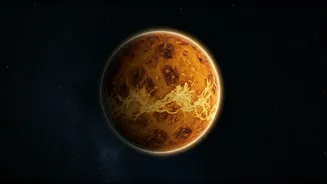
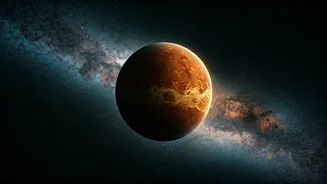
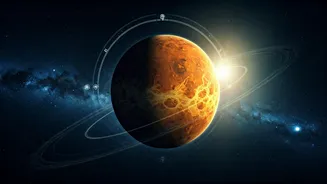
Here's where the mind-bending reality kicks in. A year on Venus—its journey around the Sun—takes approximately 225 Earth days. However, a single day on Venus—one full rotation on its axis—takes a staggering 243 Earth days. That’s right: its day is about 18 Earth days longer than its year. This means if you were standing on the surface of Venus, the planet would complete its entire orbital path around the Sun before it finished spinning around just once. It’s a concept that completely flips our earthly understanding of time on its head.
Not Just Slow, but Backwards
The strangeness doesn’t stop at its sluggish pace. Venus also spins in the opposite direction to most other planets in our solar system, including Earth. This is known as retrograde rotation. While Earth and six other planets spin counter-clockwise on their axis, Venus (and Uranus, which is tilted on its side) spins clockwise. If you could stand on Venus and survive its hellish conditions, you would see the Sun rise in the west and set in the east. This backward spin is a crucial piece of the puzzle in understanding Venus's peculiar timekeeping.
Two Kinds of Day
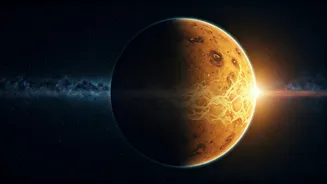
To be precise, the 243-day rotation is what astronomers call a 'sidereal day'—the time it takes to rotate once with respect to the distant stars. However, what most of us think of as a 'day' (from one sunrise to the next) is a 'solar day'. On Venus, the solar day is wildly different because of its retrograde rotation. As the planet slowly spins backward while orbiting the Sun, the time between sunrises is actually shorter than its sidereal day. A solar day on Venus is about 117 Earth days long. It’s still incredibly long, meaning you’d experience nearly two full 'years' in the time it takes for just one Venusian solar day to pass.
Why is Venus So Odd?
Scientists don't have a definitive answer for why Venus is so slow and spins backward, but the leading theory points to a violent past. It's believed that billions of years ago, a massive object—perhaps a planet-sized asteroid or another young protoplanet—collided with Venus. Such a cataclysmic impact could have been powerful enough to not only slow its rotation to a near-standstill but also completely reverse its direction. Another theory suggests that the gravitational pull of the Sun on Venus’s incredibly thick atmosphere created a 'thermal tide' that, over billions of years, acted as a brake, slowing its spin down to its current crawl.