
More Than Just a Pretty Picture
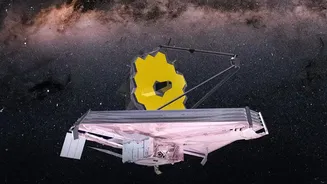
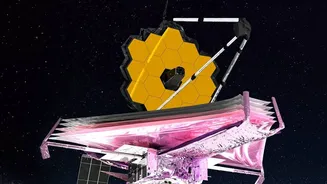
While the James Webb Space Telescope is famous for its breathtaking images of the cosmos, its most revolutionary work might be invisible to the naked eye. A primary mission for the telescope is to study exoplanets—planets orbiting stars other than our
Sun. It does this not just by trying to see them, but by dissecting the light that passes through their skies. This powerful capability allows scientists to hunt for the building blocks of life, and one of the most crucial ingredients they are searching for is water.
Decoding a Planet's Barcode
The key technique Webb uses is called transmission spectroscopy. Think of it like this: when an exoplanet passes in front of its host star from our point of view, a tiny amount of starlight filters through the planet's atmosphere. The gases in that atmosphere absorb very specific colours, or wavelengths, of light. Each molecule, like water (H2O) or methane (CH4), has a unique absorption signature, like a chemical barcode. Webb’s highly sensitive instruments, particularly its Near-Infrared Spectrograph (NIRSpec), can read this barcode. By seeing which colours are missing from the starlight, astronomers can determine with remarkable precision what the planet's atmosphere is made of.
A Clear Signature of Water
Webb has already had incredible success with this method. One of its earliest landmark observations was of the exoplanet WASP-96 b, a gas giant 1,150 light-years away, where it found the unambiguous signature of water vapour. More recently, observations of other planets have continued to build on this success. For example, studies of the hot Jupiter WASP-17b used Webb's precision to provide a well-constrained measurement of its water abundance, something that had been difficult with older telescopes like Hubble. These detections confirm that water is a common ingredient in the atmospheres of giant planets across the galaxy.
Focusing on Habitable Worlds
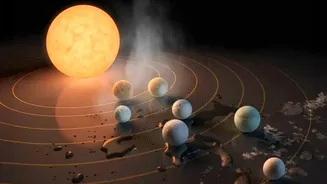
While finding water on gas giants is exciting, the ultimate goal is to analyze smaller, rocky planets in the “habitable zone”—the orbital region where temperatures could allow for liquid water on the surface. Webb has detected water vapour in the atmospheres of these smaller worlds as well. One groundbreaking discovery occurred in the PDS 70 system, where Webb found water vapour in the inner disk where rocky planets are thought to be forming. This implies that terrestrial planets could have water available to them from the very beginning of their formation. In another recent finding from August 2026, astronomers using Webb identified clear signs of water vapour around a temperate, rocky exoplanet just 48 light-years away.
A Complicated and Evolving Picture
Of course, science is never simple. Detecting water vapour in an atmosphere doesn't automatically mean a planet has oceans or life. The planet's temperature, pressure, and the presence of clouds all play a role. Webb's data from a planet called WASP-94A b, for instance, revealed a world with mineral-based clouds on its cooler side that evaporate on its hotter side, with water vapour signatures only clearly visible in the cloud-free region. This shows how complex alien weather can be. Furthermore, scientists must be careful to distinguish a signal from the planet's atmosphere versus one coming from cool spots on the star itself. These challenges are part of the process, pushing researchers to refine their models and better interpret the incredible data Webb provides.