
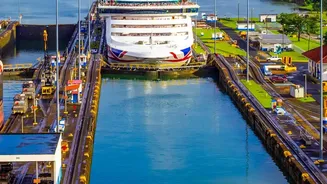
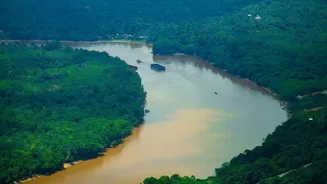
The Vision for a Blue Economy
The government's ambitious plan, crystallised in the National Waterways Act of 2016, designated 111 rivers and canals as National Waterways (NWs). This move, supplemented by initiatives like the Jal Marg Vikas Project (JMVP), aims to create a viable third
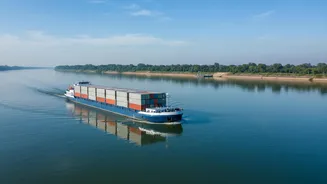
option for freight transport, especially for bulk goods. The core idea is to reduce India's heavy reliance on road and rail, which currently handle the vast majority of domestic cargo. The goal isn't to replace them, but to create an integrated multimodal system where waterways play a crucial role. This vision intends to ease congestion on land, cut down logistics costs, and provide a more environmentally friendly mode of transport for commodities like coal, cement, food grains, and fertilisers.
Waterways vs. Road: Cost Over Speed
When comparing waterways to roads, the trade-off is clear: speed for cost. Road transport offers unparalleled door-to-door connectivity but is plagued by traffic congestion, higher fuel consumption per tonne, and significant carbon emissions. For businesses, transporting goods by road is often faster but more expensive. Recent studies indicate the cost of road transport can be significantly higher than by water. While a truck might deliver goods faster for time-sensitive cargo, a single large vessel can carry the equivalent of 125 trucks, dramatically lowering the per-unit cost for bulk, non-perishable items. This makes waterways an attractive proposition for industries like cement and coal, where transport is a major component of their total cost.
Waterways vs. Rail: The Bulk Transport Rivalry
Railways have traditionally been the go-to for long-distance bulk freight, offering a more cost-effective and efficient solution than roads. The competition with waterways is more nuanced. Railways are generally faster than river transport. However, depending on the route and volume, waterways can be cheaper. For example, a 2025 government report noted the cost per tonne-kilometre for waterways was around Rs 2.30, compared to Rs 1.96 for rail and Rs 3.78 for road, though other sources suggest waterways can be even cheaper under ideal conditions. The true advantage for waterways emerges with massive, non-urgent shipments where even a small per-tonne saving adds up to a significant amount. Furthermore, waterways are significantly more fuel-efficient, using less fuel per ton-kilometre than both road and rail.
Beyond the Clock: The Real Journey
A simple comparison of transit times is misleading. The concept of 'door-to-door' journey includes first- and last-mile connectivity. A key challenge for waterways is that river terminals are often not directly connected to industrial hubs or final destinations. This adds time and cost for loading goods onto trucks or trains at both ends of the river journey. In contrast, roads offer direct point-to-point delivery. Therefore, while the on-water portion of the journey is slow but cheap, the total logistical chain can sometimes negate the cost benefits. The success of the waterways project hinges on developing robust multimodal terminals that seamlessly integrate river transport with road and rail networks.
Navigating the Practical Challenges
The path to a fully functional waterway network is not without obstacles. A primary issue is the seasonal variation in river depth, which can make navigation impossible for large vessels during dry seasons. This requires constant and expensive dredging to maintain a minimum channel depth. Reports from as recently as 2026 highlight that traffic on key routes like NW-1 has been below projected targets due to such operational challenges, including the lack of cargo for return journeys and limited night navigation infrastructure. Despite record growth in overall cargo volume on waterways, reaching over 145 million tonnes in 2024-25, realising the full potential across all 111 designated routes requires overcoming these significant practical and infrastructural hurdles.