



A Glimpse into the Cosmic Cradle
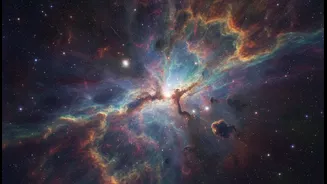
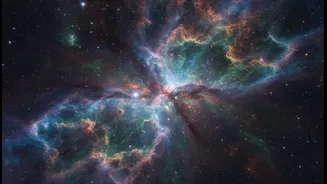
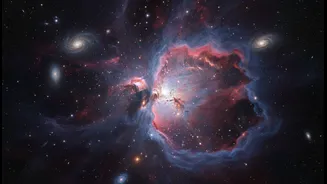
The latest image from the James Webb Space Telescope (JWST) captures a chaotic, beautiful, and crucial moment in the life of the universe: the birth of new stars. The subject is the Serpens Nebula, a vast cloud of gas and dust where gravity is pulling
matter together to ignite new suns. Unlike previous images, the JWST’s powerful infrared vision cuts through the obscuring dust, revealing details that were once hidden. The image is ablaze with color, where wisps of orange and red gas are illuminated by the light of fledgling stars, some of which are only about 100,000 years old — infants by cosmic standards. What we're seeing isn't just a static picture, but a dynamic environment where the building blocks of new solar systems are actively coming together.
The Science of Star Birth
So what are we actually looking at? Stellar nurseries like the Serpens Nebula are enormous clouds of primarily hydrogen gas and dust. Over millions of years, gravity causes denser regions of these clouds to collapse in on themselves. As a pocket of gas and dust gets smaller and denser, it heats up, forming a hot, dense core called a protostar. This is the embryonic stage of a star, before the real fireworks begin. The protostar continues to pull in more material from a surrounding disk of gas and dust. Once the core becomes hot and dense enough—reaching temperatures of millions of degrees—nuclear fusion ignites. In this process, hydrogen atoms are fused into helium, releasing an immense amount of energy. This outward pressure from fusion balances the inward pull of gravity, creating a stable, shining star.
A Never-Before-Seen Phenomenon
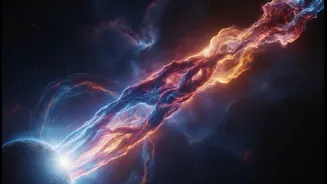
This particular view of the Serpens Nebula is exciting astronomers because it reveals something new. In one corner of the image, the JWST has captured a group of protostellar outflows—jets of gas spewing from newborn stars—that are all aligned in the same direction. Astronomers have long theorized that stars born from the same spinning cloud might have this kind of alignment, but it has never been observed so directly before. These aligned jets, seen as clumpy red streaks in the image, are a historical record of the fundamental way stars are born, confirming that they can inherit the rotation of the parent cloud they form within. Features previously seen by the Hubble telescope, like the mysterious flapping 'Bat Shadow', are also visible with new clarity at the image's center.
Why We Stare at the Stars
Studying stellar nurseries is more than just an astronomical curiosity; it's a way of understanding our own cosmic origins. The process of star formation is intimately linked to the creation of planets. The leftover disk of gas and dust that surrounds a young star is the raw material from which planets, moons, and asteroids are made. Furthermore, stars are cosmic factories. Through nuclear fusion, they forge heavier elements from simple hydrogen and helium. Elements like the carbon in our bodies, the oxygen we breathe, and the iron in our blood were all created inside stars that lived and died long ago. By watching new stars and solar systems come into being, we gain invaluable insights into the processes that eventually led to Earth and to life itself.
The Golden Age of Astronomy
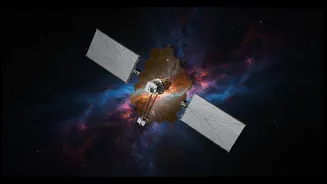
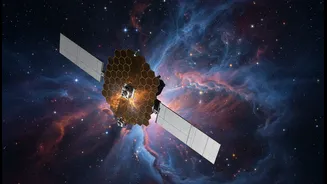
Images like this one from the Serpens Nebula underscore the revolutionary impact of the James Webb Space Telescope. Launched as the successor to the Hubble Space Telescope, its ability to observe the universe in infrared light is unlocking secrets that have been shrouded in dust until now. Each new observation brings not only stunning visuals but also data that can refine or even rewrite our understanding of the universe. For astronomers, this is just the beginning. The telescope will continue to peer into distant stellar nurseries and the atmospheres of far-off planets, helping to piece together the grand narrative of our universe, from the first galaxies to the potential for life elsewhere. The view from space has never been clearer, and the story it tells is just getting started.