



Cosmic Factories in the Void
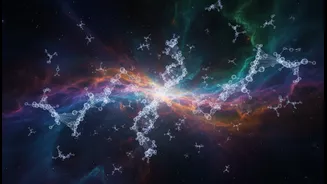
Before stars or planets exist, there are vast, cold, dark clouds of gas and dust drifting through the galaxy. These interstellar clouds may seem empty, but they are actually cosmic chemical factories. Within them, the most abundant elements in the universe—hydrogen,
helium, oxygen, carbon, and nitrogen—are brought together. Under the influence of cosmic rays and the faint light from distant stars, simple atoms begin to link up, forming molecules on the surfaces of tiny dust grains. Over millions of years, this slow and steady process builds an impressive inventory of organic compounds, which are molecules based on carbon. Recent discoveries, including those by the James Webb Space Telescope, have revealed an unexpected richness of these molecules, such as methane and benzene, even in distant galaxies, proving space is far from sterile.
From Stellar Nursery to Planetary System
Eventually, gravity causes parts of these massive clouds to collapse in on themselves. As the material gets denser and hotter at the center, a new star begins to form. The remaining gas and dust, now enriched with the organic molecules created in the cloud, flatten into a rotating frisbee of material called a protoplanetary disk. This disk is the birthplace of planets. For a long time, scientists wondered if the intense radiation from a young, blazing star would destroy these delicate organic molecules. However, observations show that many not only survive but continue to evolve. The disk provides a unique environment where these molecules can be further processed, frozen into ices, or stuck onto dust grains.
Special Delivery via Comets and Asteroids
As the protoplanetary disk evolves, the dust and ice grains begin to clump together, forming larger and larger bodies. This process of accretion builds everything from tiny pebbles to giant planetesimals, the precursors to planets. The organic molecules that were present in the original cloud and disk are incorporated into these new bodies. This means that comets and asteroids are essentially time capsules, carrying a sample of the chemical ingredients from the early days of a solar system. For billions of years, these cosmic delivery trucks have roamed the solar system. Collisions have been a constant feature, and early Earth was heavily bombarded by these organic-rich objects. This constant rain of material is believed to have delivered a vast quantity of water and organic compounds to our young planet's surface.
The Raw Materials for Life?
This leads to the most profound question: did this extraterrestrial delivery of organic molecules provide the spark for life on Earth? The theory, known as panspermia or molecular seeding, suggests that while life may not have arrived fully formed, its essential building blocks did. Meteorites that have fallen to Earth have been found to contain amino acids, which are the components of proteins. Samples returned from asteroids like Ryugu have also confirmed a rich diversity of organic compounds. While scientists have also shown that life's building blocks could have formed on early Earth, the delivery of a prebiotic toolkit from space would have provided a significant head start. It means that instead of starting from scratch, the first life forms could have self-assembled from a rich soup of complex molecules forged in the stars.