

A Cosmic Fingerprint
Imagine every element in the universe has a unique fingerprint. When you see that fingerprint, you know exactly which element you are looking at. This is the basic idea behind spectroscopy, one of the most powerful tools in astronomy. By analysing the light
from a distant star or planet, scientists can identify the chemical 'fingerprints' of the elements and molecules present there. This method allows NASA's observatories to determine the composition, temperature, and even the speed of objects that we can never hope to visit.
Decoding the Rainbow
So, how does it work? When light from a celestial object, like a star, is collected by a telescope, it’s passed through an instrument called a spectrograph. This instrument works like a prism, splitting the light into its component wavelengths—a rainbow, or spectrum. But this cosmic rainbow isn't perfect. It's interrupted by a pattern of dark or bright lines. These lines are created because different chemical elements absorb or emit light at very specific, known wavelengths. Each pattern is a unique signature. A certain pattern of lines means hydrogen is present; another pattern signals helium, oxygen, or even water vapour.
The Tools of the Trade
NASA's James Webb Space Telescope (JWST), along with its predecessors like the Hubble Space Telescope, are masters of this technique. Webb is equipped with incredibly sensitive spectrographs that are optimised to detect infrared light. This is crucial because the light from the most distant objects in the universe has been stretched into longer, redder wavelengths as the universe expands—a phenomenon called redshift. Infrared is also ideal for peering through the dense clouds of gas and dust where new stars and planets are born. In fact, about 75% of the data Webb collects is spectral data, which astronomers often say is worth more than a thousand pictures.
Unveiling Alien Atmospheres
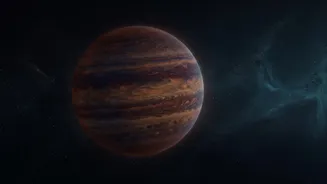
One of the most exciting applications of spectroscopy is studying the atmospheres of exoplanets—planets orbiting other stars. When an exoplanet passes in front of its host star, a tiny fraction of the starlight filters through the planet's atmosphere. The spectrographs on telescopes like Webb can analyse this filtered light. The elements and molecules in the planet's atmosphere leave their tell-tale absorption lines on the starlight's spectrum. This has allowed scientists to detect water vapour, carbon dioxide, and other molecules in the atmospheres of distant worlds, a key step in the search for potentially habitable planets.
Groundbreaking Discoveries
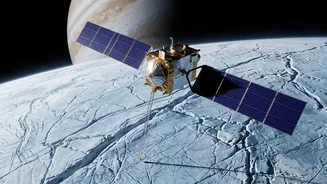
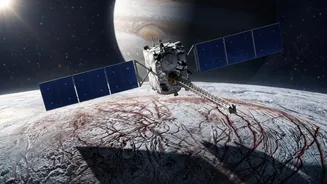
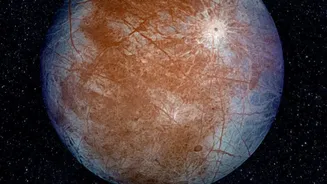
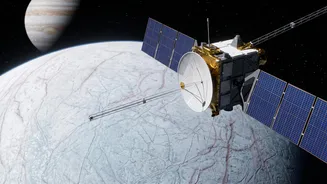
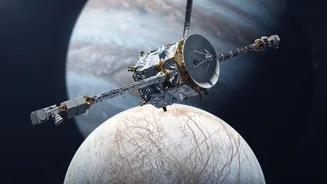
The power of spectroscopy is constantly leading to new discoveries. Recently, Webb used this technique to map carbon dioxide on the surface of Jupiter's icy moon, Europa, confirming it likely originates from its subsurface ocean. It has also been used to identify a complex mix of organic molecules in a distant galaxy, suggesting the chemistry of star-forming regions is richer than previously thought. By analysing spectra, scientists have identified the chemical makeup of the earliest galaxies, helping us understand how the elements that form everything we know, including ourselves, first came into being.