


A Portrait of a Violent Past
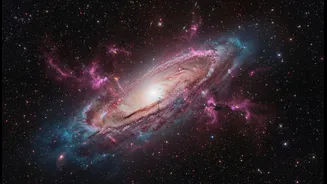
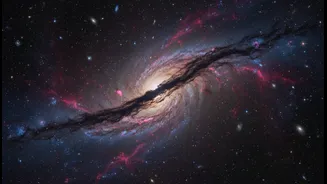
Centaurus A is not your average galaxy. While most nearby galaxies are relatively quiet, this one is buzzing with activity, making it a perfect natural laboratory for astronomers. Its peculiar shape and churning interior are the lingering scars of a cataclysmic
event: a collision with another galaxy that occurred roughly two billion years ago. This cosmic merger warped its structure, triggered waves of new star formation, and provided a feast for the supermassive black hole lurking at its core. For years, scientists have studied Centaurus A to understand how such mergers shape the universe, but a complete picture remained elusive, hidden behind a thick veil of cosmic dust.
Seeing Through the Cosmic Dust
Previous attempts to image the galaxy's heart told an incomplete story. The Hubble Space Telescope, which sees primarily in visible light, was stopped cold by the dense dust lanes that crisscross the galaxy's center. NASA's retired Spitzer Space Telescope could peer through the dust using infrared light, but it lacked the power to resolve fine details, revealing only large, blurry structures. This is where the James Webb Space Telescope changes the game. To celebrate its fourth year of science operations, NASA released images that leverage Webb's powerful infrared instruments, NIRCam and MIRI, to cut through the obscuring dust with breathtaking clarity. The result transforms a familiar celestial object into something far richer and more complex than ever seen before.
Galactic Archaeology, Star by Star
What looks like a grainy texture in Webb's new images is actually a densely packed field of millions of individual stars, now visible for the first time. This incredible resolution allows scientists to perform a kind of galactic archaeology. By mapping out the different generations of stars, they can construct a detailed timeline of Centaurus A's evolution. They can identify stars that existed before the crash, those born in the fiery burst of star formation during the collision, and newer stars created from the gas and dust stirred up in the aftermath. It’s like reading the rings of a cosmic tree, with each star holding a clue to the galaxy's dramatic history.
A Tale of Two Black Hole Traits
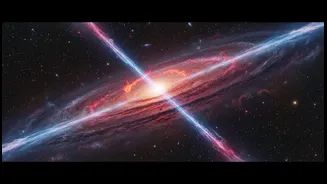
At the heart of it all is an active supermassive black hole, continuously feeding on surrounding material and blasting out powerful jets of energy. Webb's observations are providing new clarity on one of astronomy's biggest questions: how does a black hole influence its entire host galaxy? The answer, it seems, is complicated. Webb's instruments can measure the movement of gas within the galaxy, revealing a dual personality. The black hole’s activity appears to trigger star birth by compressing gas clouds, but it also limits it by violently blowing essential star-forming material away from the galaxy. Centaurus A provides a rare, close-up view of this delicate and destructive dance.
New Mysteries Revealed
While solving old mysteries, Webb has also revealed new ones. The images show intricate filaments and glowing clouds of warm dust in astonishing shapes. Astronomers were surprised to find a bizarre parallelogram-shaped structure of dust, as well as a faint, S-shaped feature curving near the galactic core. The origins of these delicate structures are not yet fully understood, but they are likely tied to the complex interplay between the past collision and the ongoing turmoil caused by the central black hole. These fresh puzzles give astronomers exciting new avenues to explore as they continue to decipher the life story of this incredible galaxy.