





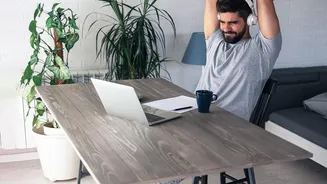
You start your workday sitting tall, feeling focused and aligned. But by 4 PM, you've mysteriously transformed into a human question mark, slumped over your keyboard. This daily postural decline isn't a personal failing; it's a predictable response to gravity
and muscle fatigue.
The Battle Your Muscles Lose Daily
Maintaining an upright posture isn't a passive state; it's an active one. Your postural muscles, including the erector spinae along your spine and your core stabilisers, work all day to keep you straight. Like any muscle, they have limited endurance. After hours of continuous static contraction, they simply get tired. As these muscles fatigue, they lose their ability to hold your spine in its optimal position, and the inevitable slouch begins. This isn't laziness; it’s a physical limit. The body, seeking the path of least resistance, allows gravity to take over, causing your shoulders to round and your head to drift forward.
The Slow Stretch Known as 'Creep'
Beyond muscle fatigue, there's a quieter, more gradual process happening in your body's soft tissues. It's a biomechanical phenomenon known as 'creep'. Think of it like a kitchen sponge with a weight on it; at first, it resists, but over time, it slowly flattens. When you hold a single position for a long time—like sitting—your ligaments and connective tissues are put under a constant, low-level load. They slowly stretch and deform. After about 20 to 30 minutes in one position, this deformation starts to set in, making it harder for your tissues to spring back to their original length. This is why you feel stiff and find it difficult to stand up straight after a long meeting or car ride.
When Joints Get 'Stuck'
Prolonged sitting creates predictable patterns of stiffness. The body is designed for movement, but desk work locks it into a fixed position. Your hips stay flexed, which can cause the hip flexor muscles at the front of your pelvis to become short and tight. Meanwhile, your upper back (thoracic spine) can become rigid in a rounded position. When these key areas lose mobility, your body is forced to compensate. To look forward, you might crane your neck, leading to 'tech neck'. To find comfort, you might slump your lower back. These compensations are the direct result of joints that are no longer moving through their full, healthy range.
Reset Your Workspace: Ergonomic Essentials
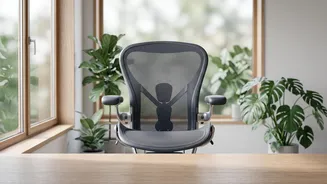
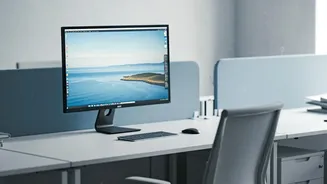
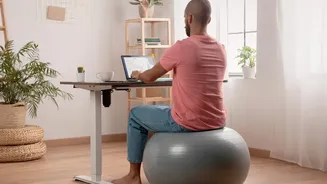
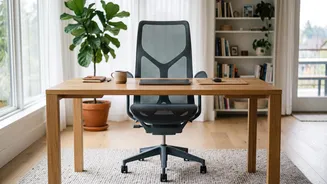
You can't eliminate sitting, but you can make your environment work for you. Start with your chair height; your feet should be flat on the floor with your thighs parallel to it. Use a lumbar support pillow or a rolled-up towel to maintain the natural curve of your lower back. Your monitor should be directly in front of you, with the top of the screen at or just below eye level, about an arm's length away. This prevents your head from drifting forward. Finally, position your keyboard and mouse so your elbows are bent at a relaxed 90-degree angle, keeping your shoulders from hunching.
Fight Stiffness with 'Movement Snacks'
The most powerful tool against postural decline is frequent movement. The goal is to break up long periods of sitting every 30–60 minutes. These don't need to be complex workouts; think of them as 'movement snacks'. Try these simple exercises at your desk:
1. Seated Spinal Rotations: Sit tall and gently twist your torso from side to side, using your chair for a light stretch. This helps mobilise your upper back.
2. Chin Tucks: Gently pull your chin straight back as if making a 'double chin'. This counteracts forward head posture.
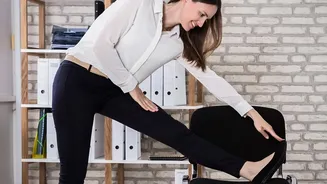
3. Standing Hip Flexor Stretch: Stand up and step one leg back into a small lunge, keeping your torso upright. You should feel a stretch at the front of your hip. This opens up the muscles that get tight from sitting.
4. Shoulder Blade Squeezes: Pull your shoulder blades together and down, as if trying to hold a pencil between them. This activates the weakened muscles in your upper back.