



What Exactly Is a Super-Earth?
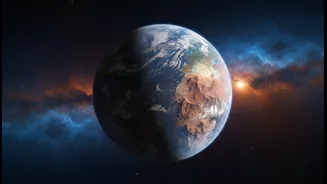
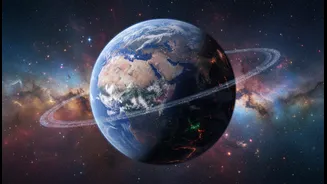
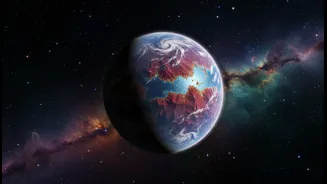
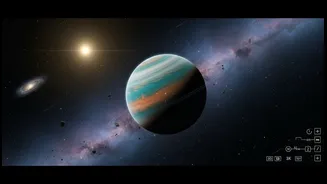
The term ‘super-Earth’ can be a bit misleading. It doesn’t mean a bigger, better version of our home planet. Instead, it’s a classification based purely on size and mass. These are exoplanets—planets outside our solar system—that are more massive than
Earth but lighter than ice giants like Neptune. They can be rocky worlds, gas dwarfs, or even water worlds, and they are surprisingly common throughout our galaxy. In fact, super-Earths are one of the most frequently discovered types of planets, yet our own solar system curiously lacks one, making every new discovery a chance to study a completely alien class of world.
Meet Our New Neighbour: GJ 3378b
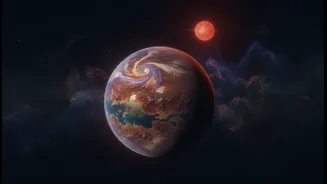
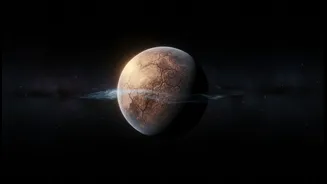
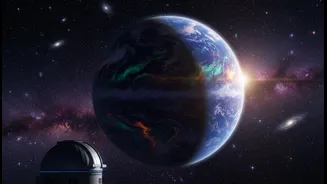
The planet sparking the latest wave of excitement is GJ 3378b. Located just 25 light-years away, it’s practically on our doorstep in galactic terms. Initially identified in 2024, recent observations confirmed its existence and provided a clearer picture of its characteristics. It’s about twice the size of Earth and has roughly 2.3 times our planet's mass, confirming its status as a rocky super-Earth rather than a gassy mini-Neptune as first suspected. It orbits a red dwarf star, which is smaller and cooler than our Sun. While Earth takes 365 days to circle the Sun, GJ 3378b completes its orbit in just 21 days, hugging its star much more tightly.
The ‘Goldilocks’ Promise
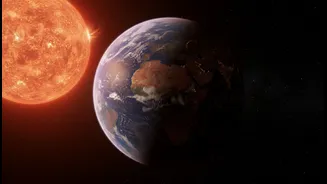
What makes GJ 3378b so compelling is its location within its star’s habitable zone, often called the ‘Goldilocks zone’. This is the orbital range where temperatures are just right—not too hot and not too cold—for liquid water to potentially exist on a planet's surface. Liquid water is considered the most critical ingredient for life as we know it. Researchers estimate that GJ 3378b receives about 90% of the stellar radiation that Earth gets from the Sun, placing it in a ‘sweet spot’ for potential habitability. This balance of energy raises the tantalising possibility of surface conditions that are not wildly different from our own.
The Great Unproven: The Atmosphere Question
Here’s where the scientific caution comes in. A planet’s position in the habitable zone is just one piece of the puzzle; without the right atmosphere, it’s not truly habitable. And right now, we have no idea if GJ 3378b has an atmosphere at all. It could be an airless, cratered rock. Red dwarf stars, while long-lasting, are known for their violent flares, which can strip atmospheres from closely orbiting planets. GJ 3378b orbits on the very edge of the zone where this radiation stripping is a major risk. Even if it has an atmosphere, it could be a crushing, toxic one like that of Venus, which also lies within our Sun’s habitable zone but is a scorching hellscape. The simple truth is, from 25 light-years away, we just can't tell yet.
What Comes Next in the Search?
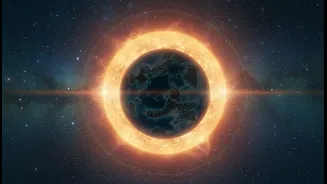
The confirmation of GJ 3378b isn’t an end point, but a starting line. Its proximity and tantalising characteristics make it a prime target for the next generation of powerful observatories, particularly the James Webb Space Telescope (JWST). The next step is to use a technique called transmission spectroscopy. When the planet passes in front of its star from our perspective, a tiny fraction of starlight will filter through its atmosphere, if one exists. By analysing this light, scientists can detect the chemical fingerprints of gases like oxygen, methane, or water vapour. These ‘biosignatures’ would be the first concrete evidence that this nearby world is more than just a promising rock. The search for these signs will be a long, patient process, but one that could fundamentally change our understanding of our place in the universe.