




More Than Just a Light Show
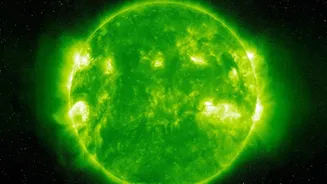
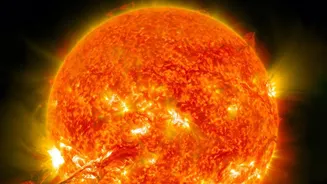
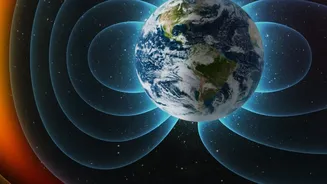
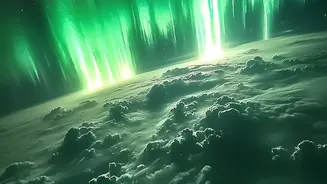
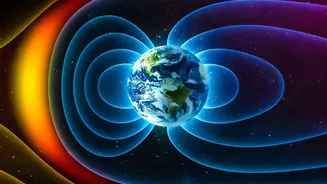
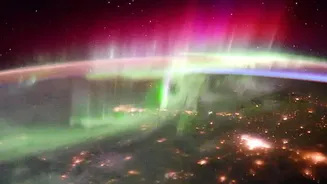
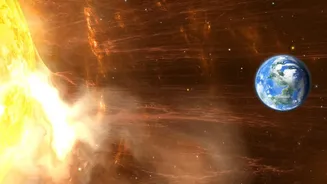
For centuries, the aurora borealis and australis have captivated sky-gazers. We now know they are created when charged particles from the sun, carried on the solar wind, slam into Earth's protective magnetic field. This interaction funnels energetic particles towards
the poles, where they collide with oxygen and nitrogen in the upper atmosphere, releasing energy as vibrant curtains of green, red, and purple light. But this beautiful display is just the visible symptom of a planet-wide phenomenon known as a geomagnetic storm. These storms are powerful disturbances in Earth's magnetic field, and their effects are not limited to the sky. The same forces that paint the heavens with light are also inducing powerful electrical currents deep within the Earth's crust.
The Hidden Electrical Circuit
Think of a geomagnetic storm as a complete electrical circuit. The dazzling aurora is one part, caused by currents flowing in the ionosphere, about 100 kilometres up. These are known as auroral electrojets. However, as fundamental physics dictates, a changing magnetic field induces an electrical current in any nearby conductor. The Earth itself, with its layers of rock, water, and metallic ores, is a massive, if imperfect, conductor. As the magnetic field fluctuates wildly during a storm, it creates powerful, unseen rivers of electricity that flow through the ground. These are called geomagnetically induced currents, or GICs. So, when you see an aurora moving and intensifying, it's a visual tracer for rapid magnetic changes that are generating GICs on and below the surface.
Connecting the Sky and the Ground
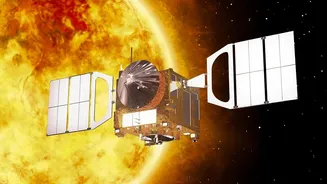
The latest scientific efforts are focused on understanding this complete system. Researchers are no longer studying the auroras in the sky and the magnetic changes on the ground as separate events. Instead, they are combining data from multiple sources to see the whole picture. Satellite missions, such as NASA's THEMIS spacecraft, observe the release of energy in Earth's magnetic field tens of thousands of kilometres away. Simultaneously, networks of ground-based magnetometers measure the resulting changes in the magnetic field at the surface. By correlating these data sets, scientists can directly link a specific disturbance in space to the auroral display and the intensity of the induced currents beneath it. This holistic approach provides a crucial understanding of how energy from the sun flows through the Earth system.
Why This Research Matters for India
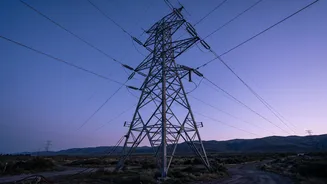
While India is too far from the magnetic poles to witness auroras, the country is not immune to the effects of geomagnetic storms. The geomagnetically induced currents (GICs) are a global phenomenon. These powerful, low-frequency currents pose a significant risk to modern technological infrastructure. They can flow into long conductors like high-voltage power transmission lines, overloading transformers and potentially causing widespread blackouts. The infamous 1989 storm, for example, caused the collapse of the Hydrost Québec power grid in Canada, leaving millions without electricity for hours. GICs can also accelerate the corrosion of oil and gas pipelines and interfere with railway signalling systems, creating significant safety and economic risks. As our society becomes ever more reliant on technology, from GPS navigation to stable power grids, understanding and forecasting these events is a matter of national importance.