



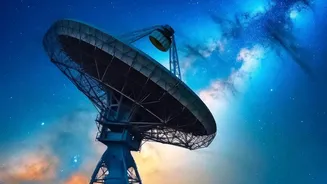
The World's Largest Telescope
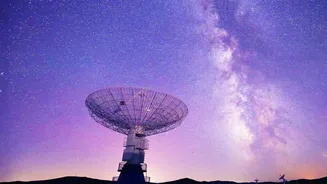
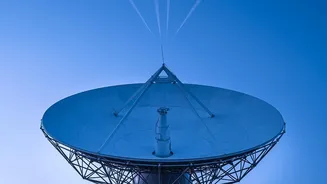
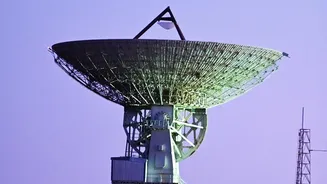
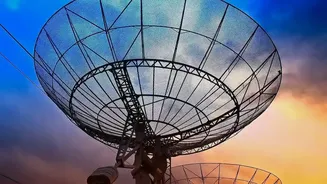
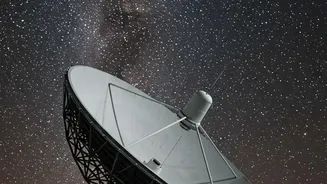
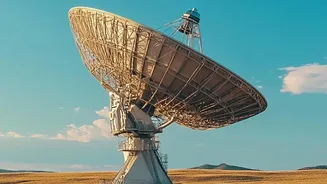
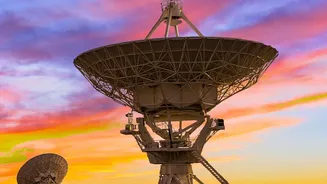
First, let's clear up a common misconception: the Square Kilometre Array isn't a single telescope. It's a vast, intergovernmental project building the two largest and most complex radio telescope networks in the world. The SKA-Mid array, featuring hundreds
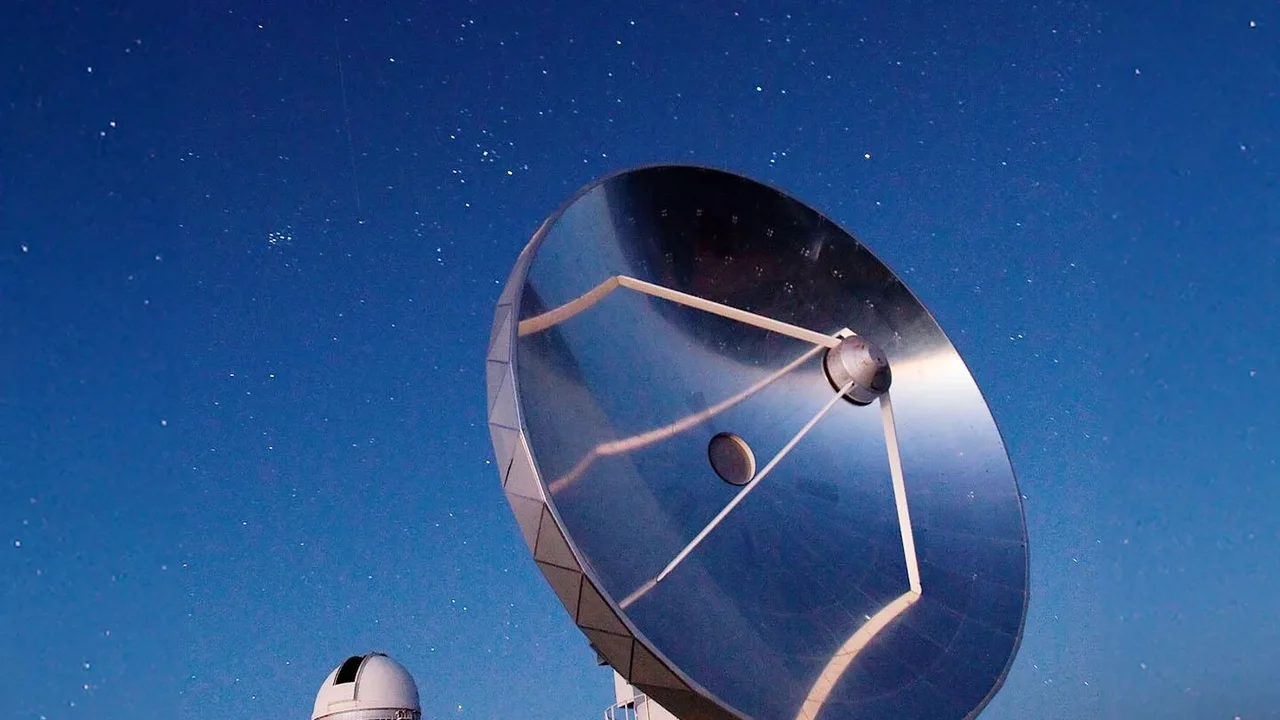
of dish antennas, is located in South Africa's Karoo region, while the SKA-Low array, composed of over 130,000 smaller, Christmas-tree-like antennas, is in Western Australia. These sites were chosen for their remote locations, which offer pristine, radio-quiet skies essential for detecting the faint cosmic signals from the dawn of time. The project's headquarters, coordinating this global effort, is at the Jodrell Bank Observatory in the UK. The name itself refers to the ultimate goal: a total collecting area of one square kilometre, making it 50 times more sensitive than any previous radio instrument.
Peering into the Cosmic Dawn
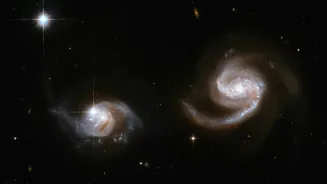
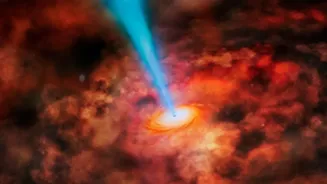
The headline achievement is mapping the "early universe." Specifically, astronomers are targeting a period known as the Cosmic Dawn and the subsequent Epoch of Reionization. This was the time, from a few hundred million to about a billion years after the Big Bang, when the first stars and galaxies ignited, ending the cosmic 'dark ages'. Their intense radiation began to ionize the vast clouds of neutral hydrogen that filled the universe. The SKA is designed to detect the faint radio signal from this primordial hydrogen, specifically its '21-centimetre line' emission. By capturing this signal, scientists can create 3D maps showing how the universe transformed from a uniform, dark expanse into the structured, light-filled cosmos we know today. It’s like creating a historical atlas of the universe's first major transition.
A Global Technological Symphony
Making this happen requires an incredible synthesis of global technology. The 'Global Radio Dishes' in the headline alludes to the technique of interferometry. By combining the signals from thousands of antennas spread over vast distances, the SKA effectively creates a single, continent-sized virtual telescope. This provides the extraordinary resolution needed to distinguish faint, distant objects. The SKA-Mid telescope in South Africa recently achieved a major milestone known as "first fringes" in January 2026, where two dishes successfully worked together as an interferometer for the first time, proving the core concept works as designed. The sheer volume of data is staggering, requiring processing power and software of a scale that pushes the boundaries of big data and computing, presenting unique opportunities for technology companies and data scientists worldwide.
India's Pivotal Role
India is not just a bystander in this cosmic exploration; it is a key player. Having formally joined the SKA Observatory (SKAO) as a full member, India's involvement is deep and multifaceted. The Indian government approved participation with a substantial commitment of ₹1250 crore. Coordinated by the National Centre for Radio Astrophysics (NCRA), a consortium of over 20 Indian institutions has been instrumental from the start. Indian teams led the design of the Telescope Manager system—the 'brain' and 'nervous system' of the entire observatory—and are now supervising its expanded construction. Furthermore, India's own Giant Metrewave Radio Telescope (GMRT) serves as a vital 'pathfinder' facility, providing crucial expertise and data. Indian scientists are involved in numerous science working groups, gearing up to use the SKA for cutting-edge research.
Why This Map Matters
Mapping the early universe is about answering some of the most fundamental questions of our existence. How did the first stars form, and what were they like? How did these stars assemble into the first galaxies? By studying the Epoch of Reionization, scientists can test theories about galaxy formation and evolution. These observations also provide a new way to probe the nature of dark matter and dark energy, the mysterious components that dominate our universe. And, perhaps most profoundly, the SKA's unprecedented sensitivity will dramatically expand the search for extraterrestrial intelligence (SETI), capable of detecting 'leakage' radiation equivalent to a mobile phone network on a planet light-years away. It transforms the search from looking for a deliberate beacon to listening for the background hum of a technological civilization.