






A Landmark Discovery in the Cosmos
Astronomers have long dreamt of peering into the skies of rocky planets beyond our solar system. The James Webb Space Telescope (JWST) has turned that dream into a stunning reality. In a landmark observation, scientists have found the strongest evidence
to date of an atmosphere surrounding a rocky 'super-Earth' named 55 Cancri e. Located 41 light-years away, this planet has been a source of intense study, but its nature remained a mystery. Previous observations couldn't definitively say whether it was a bare rock or a world shrouded in gas. This new finding, made possible by the unparalleled power of the JWST, pushes the boundaries of exoplanet science and redefines what we thought was possible for planets in extreme environments.
Meet 55 Cancri e: A World of Fire
To call 55 Cancri e 'rocky' might conjure images of Earth or Mars, but it couldn't be more different. This super-Earth is nearly twice the diameter of our planet and about eight times more massive. It orbits its star at a blistering proximity—just a fraction of the distance between Mercury and our Sun—completing a full 'year' in less than 18 hours. This incredibly tight orbit means the planet is tidally locked, with one side perpetually facing its star in endless daylight and the other in permanent darkness. The consequence is a surface so hot it is likely a bubbling, churning ocean of molten magma. This is not a gentle world; it is a veritable hellscape, which makes the discovery of its atmosphere all the more shocking.
How Webb Sensed a Distant Atmosphere
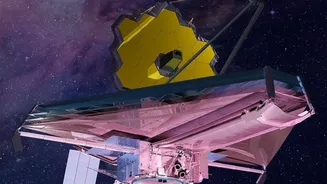
The JWST cannot take a direct picture of 55 Cancri e. Instead, it uses a brilliant technique called spectroscopy. Scientists pointed the telescope’s sensitive infrared instruments, NIRCam and MIRI, at the system to measure the thermal emissions—the heat—coming from the planet itself. By observing the subtle changes in light as the planet moved, they could deduce its temperature. The data showed that the planet’s dayside was cooler than it should be if it were just bare, superheated rock. This suggests that an atmosphere is present, circulating some of that intense heat from the star-facing side to the night side. It's a masterful piece of cosmic detective work, using temperature readings to infer the presence of a gaseous envelope from trillions of kilometres away.
An Atmosphere Forged in Magma
So where did this atmosphere come from? Given the intense heat and radiation from its star, any primordial atmosphere the planet had would have been stripped away long ago. The leading theory is that this is a 'secondary atmosphere,' one that is constantly being replenished. Scientists believe the gases are bubbling out of the molten magma ocean itself, which contains a great deal of dissolved gas, much like a can of soda. The atmosphere is therefore likely rich in heavier molecules like carbon dioxide and carbon monoxide. While the headline discovery is the atmosphere itself, this carbon-rich mix could also contain other compounds, including hints of water vapour, that are being released from the planet's molten interior.
Why Finding Air on a Lava Planet Matters
Finding a substantial atmosphere on a world like 55 Cancri e is a game-changer. It fundamentally challenges theories about planetary evolution, which predicted that a planet this close to its star should be an airless, scorched core. This discovery proves that rocky planets can hold onto—or continuously generate—atmospheres even under the most hostile conditions. This significantly broadens the types of planets where astronomers can search for atmospheres, a key ingredient for habitability. While 55 Cancri e is far too hot for life as we know it, its existence serves as an extraordinary proof of concept. It demonstrates the JWST's power to characterize rocky worlds and provides a crucial data point in our quest to understand the vast diversity of planets in our galaxy.