






More Than Just Clothes
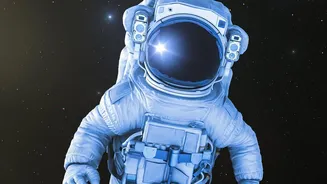
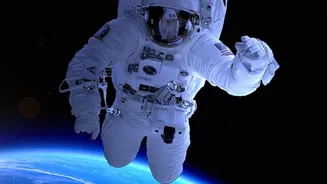
Calling an Extravehicular Mobility Unit, or EMU, a 'suit' is a massive understatement. It's a self-contained system designed to protect against the vacuum of space, extreme temperatures, radiation, and tiny, fast-moving space debris. Without it, an astronaut
would lose consciousness in about 15 seconds due to lack of oxygen, and their body fluids would boil in the near-total vacuum. The suit creates a pressurized, oxygen-rich environment that essentially brings a small piece of Earth into space, allowing an astronaut to work for hours outside the safety of their craft.
A Personal Life-Support Backpack
The heart of the spacesuit's life-sustaining capability is the Primary Life Support System (PLSS), a backpack worn by the astronaut. This unit contains tanks of pure oxygen for breathing and pressurizing the suit. As the astronaut exhales carbon dioxide, a fan circulates the air through a filtration system to scrub the CO2, keeping the breathing air clean. The PLSS also houses a two-way radio for communication, electrical power for the suit's systems, and the crucial water-cooling equipment.
Surviving Extreme Temperatures
In Earth's orbit, an astronaut can experience temperatures ranging from a scorching 121°C in direct sunlight to a frigid -157°C in the shade. To manage these wild swings, the suit relies on multiple strategies. The outermost layers are white to reflect as much solar radiation as possible. Underneath are multiple layers of insulation, much like a thermos, including materials like aluminized Mylar. However, the biggest challenge is often removing the heat generated by the astronaut's own body. This is handled by the Liquid Cooling and Ventilation Garment, a spandex-like undergarment with about 91 meters of thin tubes woven into it. Water circulated through these tubes absorbs body heat, then flows to the PLSS backpack where a device called a sublimator allows some of the water to escape into space as ice crystals, carrying excess heat away with it.
A Multi-Layered Shield
A modern spacesuit like the EMU can have as many as 14 distinct layers. Each one serves a purpose. Closest to the skin is the cooling garment. Above that sits a urethane-coated nylon 'bladder' layer which holds the pressure, and a restraint layer to prevent the bladder from ballooning outwards. The outer layers form a Thermal Micrometeoroid Garment. This tough shell, made of a blend of materials including Kevlar and Gore-Tex, is designed to protect the astronaut from impacts with tiny particles of space dust and debris, which can travel at speeds of up to 27,000 kilometres per hour. While the suit offers some shielding from ultraviolet radiation, particularly through the gold-lined helmet visor, protection from heavy particle radiation remains limited; spacewalks are typically scheduled during periods of low solar activity to minimize exposure.
A Room with a View
The helmet provides a pressurized bubble of oxygen and a panoramic view, but it's also a critical piece of protective gear. It's made of strong polycarbonate and features an Extravehicular Visor Assembly. This assembly includes a protective visor to shield against scratches and micrometeoroid impacts, a sun visor to reduce glare, and a gold-coated visor that reflects harmful solar radiation, acting like a super-powered pair of sunglasses. The helmet also houses the communications cap, often called a 'Snoopy cap', which contains the earphones and microphones astronauts use to speak with each other and mission control on the ground.