



A Cosmic Chemical Factory
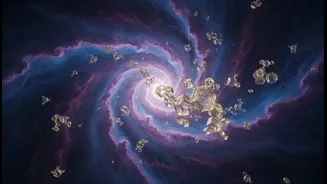
In a remarkable finding, scientists using the powerful James Webb Space Telescope (JWST) have identified an extraordinary abundance of small organic molecules deep within a nearby galaxy. The discovery was made in a galaxy named IRAS 07251–0248, an ultra-luminous
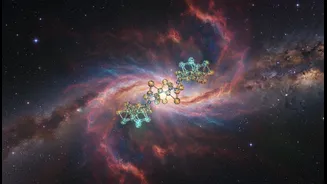
infrared galaxy whose core is so thick with gas and dust that it's nearly impossible to study with conventional telescopes. The team found a complex chemical cocktail that includes familiar names like methane and benzene, but also more exotic compounds like diacetylene and triacetylene. Perhaps most exciting was the first-ever detection of the highly reactive methyl radical (CH₃) outside of our own Milky Way, a molecule that is a key component in more complex organic chemistry.
Piercing the Dusty Veil
Observing the centre of a galaxy is notoriously difficult. The sheer density of stars, gas, and cosmic dust blocks most forms of light, creating a 'zone of avoidance' for many instruments. However, the JWST is designed to see the universe in infrared light, which can penetrate these dusty clouds. By combining data from its Near-Infrared Spectrometer (NIRSpec) and Mid-Infrared Instrument (MIRI), researchers were able to analyse the chemical fingerprints of the material hidden within the galaxy's core. This allowed them to identify not just which molecules were present, but also their abundance, revealing a chemical richness that current theories of astrochemistry did not predict.
What Are These 'Organic' Molecules?
The term 'organic' in chemistry simply refers to molecules that are based on carbon, and it doesn't automatically imply a connection to life. Many of these compounds, known as Polycyclic Aromatic Hydrocarbons (PAHs), are common on Earth, found in soot, exhaust, and even on grilled food. In space, however, they are not formed by living processes but are thought to be created in the cooling atmospheres of old stars or in dense interstellar clouds. While not alive themselves, these molecules are considered crucial precursors for life. They represent the fundamental building blocks from which more complex structures, like the amino acids that form proteins, can eventually be assembled.
Fuelled by Cosmic Rays
The sheer quantity of these organic molecules was a surprise, leading scientists to question how they were being formed and sustained. The leading theory is that the intense environment of the galactic nucleus is the key. High-energy particles called cosmic rays, which are common near supermassive black holes, are thought to be smashing into larger carbon-rich dust grains. These impacts shatter the grains, releasing a continuous supply of smaller carbon fragments and molecules into the surrounding gas. This process turns the galaxy's hidden core into a powerful and efficient factory for producing the ingredients for complex chemistry, a process that was previously thought to happen much more slowly in colder, quieter regions of space.