


A Faint Discovery in the Outer Darkness
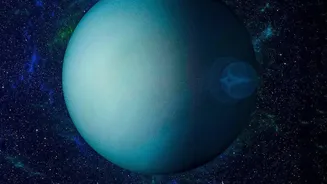
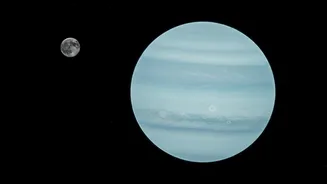
The newest member of Uranus's celestial family is provisionally named S/2023 U1. It is the first new moon found around the planet in over two decades. This is no giant sphere; initial estimates suggest it is incredibly small, perhaps only 8 kilometres
in diameter, making it one of the tiniest known moons in our solar system. Its discovery was a triumph of modern astronomy, spotted by Scott S. Sheppard using the powerful Magellan telescopes in Chile. Finding such a faint object required special image processing techniques, effectively stacking multiple long-exposure images to reveal objects that would otherwise be lost in the darkness of deep space.
An Orbit on the Outskirts
S/2023 U1 is what astronomers call an 'irregular' moon. Unlike the larger, more orderly moons that orbit close to Uranus's equator, this tiny world follows a distant and highly inclined path. It takes a staggering 680 Earth days for this moon to complete a single journey around its parent planet. This long, looping orbit suggests that S/2023 U1 was not born alongside Uranus but was likely a passing object captured by the ice giant's immense gravity millions or even billions of years ago. This capture theory is common for the outer, irregular moons of giant planets, which often have similarly strange, retrograde, or tilted orbits.
A System Tilted on Its Side
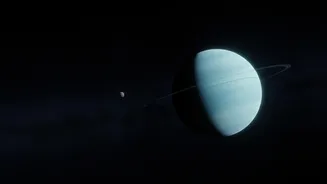
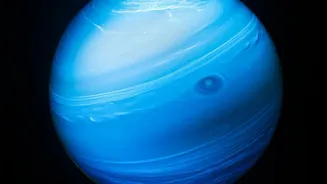
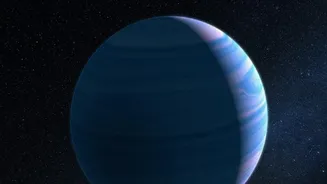
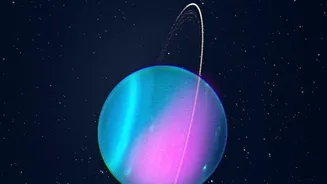
The discovery brings the total count of Uranus’s known moons to 28, adding to what is already the most peculiar satellite system in the solar system. The entire Uranian system is famous for being tilted on its side, likely due to a cataclysmic collision with an Earth-sized object in its distant past. This gives the planet its bizarre orientation, where it essentially rolls around the Sun. Its major moons orbit this tilted equator, appearing to go up and over the planet from our perspective. This new moon, however, is part of a different group—the irregulars—that orbit far beyond this tilted plane, adding to the system’s complexity.
A Family of Literary Characters
While most moons in the solar system are named after figures from Greek and Roman mythology, Uranus's family is unique. Its moons are named for characters from the works of William Shakespeare and Alexander Pope. We have major moons like Titania and Oberon (from 'A Midsummer Night's Dream'), Ariel and Miranda (from 'The Tempest'), and Umbriel (from Pope's 'The Rape of the Lock'). Following this tradition, S/2023 U1 will eventually shed its scientific designation and receive a permanent, literary name once its orbit is fully confirmed by the International Astronomical Union. It joins a rich cast of characters that includes Juliet, Puck, Desdemona, and Cordelia, turning the Uranian system into a celestial stage.
Why Small Moons Matter
Finding a small moon like S/2023 U1 might seem minor, but it's a crucial piece of the planetary puzzle. The distribution and orbits of these tiny outer moons provide vital clues about the history of the solar system. They act as fossil remnants from the era of planet formation, helping scientists model how the giant planets migrated and gathered their satellite families. Each new discovery helps refine our understanding of the gravitational dynamics at play in the outer solar system. Furthermore, it highlights how much is still left to discover. Even with powerful modern telescopes, our cosmic backyard continues to hold surprises, reminding us that there is always more to explore.