


Venus: Earth's Hostile Sibling
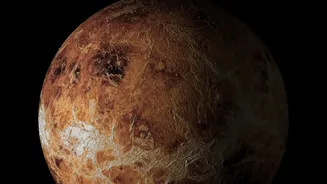
Imagine a planet roughly the same size as Earth, yet with a surface hot enough to melt lead and an atmosphere so dense it would crush a submarine. That’s Venus. Its skies are filled with clouds of sulfuric acid, and it suffers from a runaway greenhouse
effect that makes it the hottest planet in our solar system. For decades, this hostile environment has hidden its secrets, but understanding why our planetary twin took such a different evolutionary path is a key scientific question. Answering it could offer profound insights into planetary formation, climate change, and what makes a world habitable. This is the challenge that the Indian Space Research Organisation (ISRO) is undertaking with its ambitious Venus Orbiter Mission, Shukrayaan-1.
Shukrayaan-1: India’s Next Interplanetary Leap
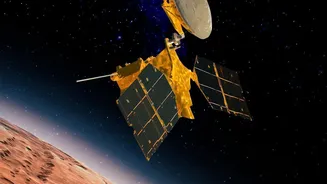
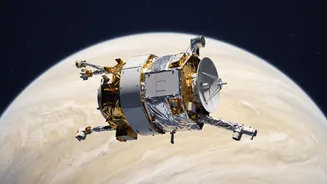
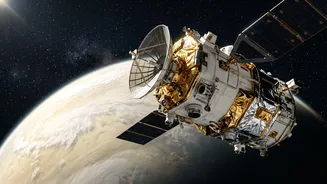
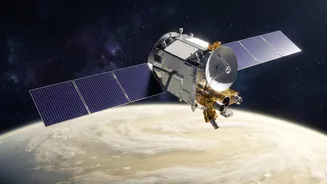
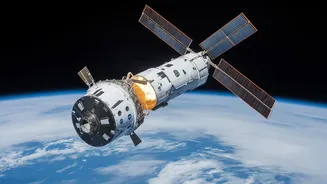
Following the success of its missions to the Moon and Mars, ISRO is setting its sights on Venus. The Shukrayaan-1 orbiter is a testament to India's growing technological prowess in space exploration. Scheduled for launch in the coming years, the spacecraft will carry approximately 100 kilograms of scientific instruments into a carefully planned orbit around Venus. This will not be a fleeting visit; the mission is designed to study the planet for several years. Its primary goals are to map the Venusian surface and subsurface, analyze the complex dynamics of its atmosphere, and study the planet's interaction with the ever-present solar wind. To achieve this, the mission will rely on a new generation of advanced sensors, some developed in India and others through international collaboration.
Decoding the Atmosphere with Light
The key to reading chemical signals from orbit lies in a technique called spectroscopy. Every chemical element and compound absorbs and emits light at specific, unique wavelengths, creating a sort of 'chemical fingerprint'. Shukrayaan-1’s sensors are designed to capture and analyze this light. The main challenge on Venus is its incredibly thick cloud cover. However, scientists have discovered that there are narrow 'windows' in the infrared spectrum where the atmosphere becomes partially transparent. ISRO's instruments will peer through these windows to see the chemistry unfolding below. One of the key instruments for this task is the Venus Infrared Atmospheric Gases Linker (VIRAL), a payload developed in collaboration with Russian and French space agencies. This instrument, along with other spectrometers, will scan for the tell-tale signatures of gases vital to understanding the planet.
The Search for Volcanic and Chemical Clues
So what exactly will these sensors be looking for? The list includes gases like sulphur dioxide, which could be a sign of active volcanism. Detecting and mapping these gases can help scientists pinpoint volcanic hotspots on the surface, a feat that would be accomplished in tandem with the orbiter’s high-resolution Synthetic Aperture Radar (SAR), which can see through the clouds. The mission will also search for signatures of water vapor, which could help solve the mystery of whether Venus once hosted oceans. Perhaps most tantalizingly, Shukrayaan-1’s sensors will be capable of searching for phosphine. The potential detection of this gas in the Venusian clouds by other telescopes a few years ago caused a major stir, as on Earth, it is primarily produced by microbial life. Shukrayaan’s measurements could provide definitive evidence to either confirm or refute this extraordinary claim.