


Sailing on Beams of Light
The concept of a solar sail is elegant and surprisingly simple. Light, though it has no mass, is made of particles called photons that carry momentum. When these photons strike a vast, reflective sail in the vacuum of space, they transfer that momentum,
giving the spacecraft a tiny but continuous push. Unlike chemical rockets that provide a powerful, short-lived burst of thrust, a solar sail provides very little force at any given moment. However, because this push is constant and requires no fuel, a solar sail-powered craft can achieve incredible speeds over time. Missions like Japan's IKAROS and The Planetary Society's LightSail 2 have already proven that this technology works, successfully demonstrating controlled solar sailing in Earth orbit and beyond. These missions have paved the way for more ambitious projects, moving solar sailing from a novel experiment to a viable propulsion system.
The Challenge of Steering
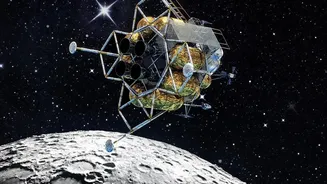
Propulsion is only half the battle; navigation is the other. Steering a spacecraft that is constantly being pushed by the Sun is not as straightforward as turning a rudder in the wind. To change direction, the spacecraft must change its orientation relative to the Sun. By angling the sail, operators can control the direction of the photonic push, allowing the craft to speed up, slow down, or even spiral inwards toward the Sun. This requires incredibly precise control systems and new materials. The breakthrough in this field comes from developing advanced, lightweight composite booms—the structures that hold the sail taut. These new booms, tested on NASA's Advanced Composite Solar Sail System (ACS3) mission, are stiffer and lighter than previous designs, allowing for the deployment of much larger sails from very small, cost-effective spacecraft. Packing a sail the size of a small apartment into a satellite no bigger than a microwave is the kind of innovation that unlocks new possibilities.
New Navigational Horizons
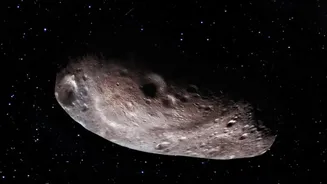
The true breakthrough lies in proving these new, large structures can be precisely controlled for navigation. The ACS3 mission aims to demonstrate that these advanced composite booms can successfully deploy and hold a large sail, after which the team hopes to prove its ability to change the spacecraft's orbit by angling the sail. This capability is critical for complex journeys, such as those to near-Earth asteroids (NEAs). Missions like the NEA Scout, which was designed to hitch a ride on the Artemis I launch, are planned to use solar sails for long-duration journeys to observe asteroids up close. Without the need for heavy propellant, these lightweight probes can travel for years, making them perfect for visiting multiple targets or performing slow, detailed flybys that would be impossible for fuel-constrained missions.
Why Asteroids Are a Prime Destination
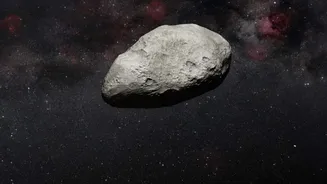
Asteroids are compelling targets for several reasons, and solar sails are uniquely suited to get us there. These celestial bodies are remnants from the formation of our solar system, holding clues to our cosmic origins. They are also potential sources of valuable resources and, in some cases, a potential threat to Earth. Solar sail probes, being lightweight and fuel-free, dramatically lower mission costs. This allows for the possibility of launching not just one probe, but entire fleets of small, 10-gram spacecraft to visit thousands of near-Earth asteroids. This 'swarm' approach could accelerate our discovery and characterization of these objects, providing crucial data for science, resource prospecting, and planetary defense far more efficiently than traditional, one-off missions.
The Future of Fuel-Free Exploration
The successful demonstration of advanced solar sail navigation opens a new chapter in space exploration. The technology could support future sails as large as half a soccer field, enabling more ambitious missions. These could include stationing solar weather warning satellites closer to the Sun than ever before to provide earlier storm warnings, or sending probes on 'fast transit' journeys to the outer solar system, reaching destinations in a fraction of the time required by conventional rockets. Some researchers even envision using powerful lasers to push sails, a concept known as 'beam sailing,' which could propel probes to interstellar space at a significant fraction of the speed of light. While that remains a distant dream, the current breakthroughs are turning solar sails into a workhorse technology for exploring our own cosmic backyard.