




A Ten-Sided Surprise
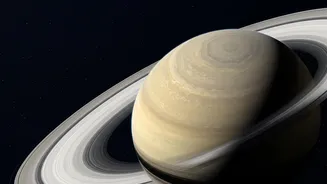
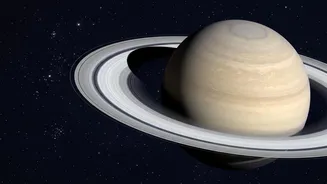
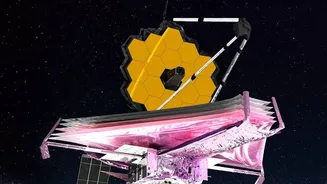
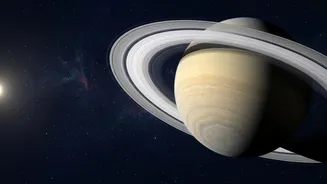
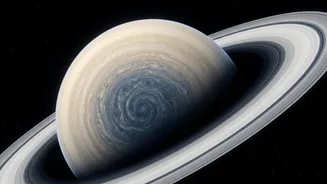
In a discovery that has reshaped our understanding of the ringed giant, NASA's Hubble Space Telescope has spotted a colossal 10-sided weather pattern, or decagon, swirling around Saturn's south pole. This is not a feature that has been lurking there for
ages. The Cassini spacecraft, which orbited the planet from 2004 to 2017, saw no such long-lived structure. The discovery was a collaborative effort, sparked by keen-eyed amateur astronomers who noticed a faint, wavy feature in 2024 and 2025 images as Saturn's south pole tilted back towards Earth after being hidden from view for years. Subsequent high-resolution images from Hubble confirmed their suspicions, tracing the feature's emergence back to at least 2023 and revealing a complex, evolving polygonal wave.
The Famous Hexagon's New Sibling
For over 40 years, Saturn's northern hexagon has been an icon of the solar system—a freakishly stable, six-sided jet stream wider than two Earths. Scientists had long searched for a similar structure in the south, but found nothing, leading many to believe the hexagon was a one-of-a-kind anomaly. This new decagon proves that Saturn’s atmosphere can indeed create polygons at both poles. However, the two are not identical twins. While the hexagon is a rigid, persistent feature that has remained almost unchanged for decades, the southern decagon appears much younger and more dynamic. Its sides are uneven and its corners seem to shift, giving astronomers the sense that they are watching a massive weather system in the middle of being born.
The Science of Swirling Shapes
How can a planet's atmosphere create such perfect-looking geometry? Unlike Earth, where mountains and oceans disrupt air currents and create messy weather, gas giants like Saturn are almost entirely atmosphere. This allows powerful jet streams—rivers of wind racing around the planet—to flow along a much smoother track. Scientists believe these geometric shapes are standing waves within those jets. Small disturbances, like other storms, can effectively 'pinch' the jet stream at regular intervals, forcing the flow into a polygonal shape. The northern hexagon is thought to have formed this way, with the physics of the wind speeds and planetary rotation naturally settling on six sides. The decagon appears to be a similar phenomenon, a massive wave rippling through a jet stream deep in the planet's atmosphere.
A Once-in-a-Generation Opportunity
The timing of this discovery is what makes it so thrilling for planetary scientists. Because the decagon is a new feature, they have a front-row seat to its formation—a rare opportunity to watch a planetary-scale weather system assemble itself in real time. The northern hexagon was already fully formed when the Voyager spacecraft discovered it in the 1980s. By tracking how the decagon strengthens, changes shape, or potentially breaks apart, researchers can test and refine their models of atmospheric physics. Saturn's southern hemisphere is currently moving into its summer, and the increased sunlight could further influence the storm's evolution, offering more clues about the forces that sculpt these incredible patterns.
Beyond Just One Planet
Understanding how and why Saturn creates these polygons has implications far beyond our own solar system. It provides a crucial second data point after decades of only having the hexagon to study. This knowledge sharpens the tools scientists use to analyze the atmospheres of distant exoplanets and brown dwarfs. By studying the intricate dance of jets and vortices on a world we can observe in detail, we learn what to look for on worlds that appear only as faint points of light. The discovery of the decagon is a powerful reminder that even familiar celestial neighbors can still hold profound surprises, and that the universe is filled with elegant, underlying patterns waiting to be found.