






A Landmark Discovery in the Stars
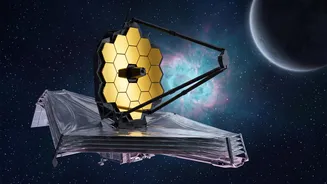
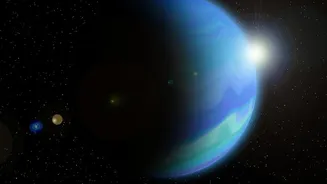
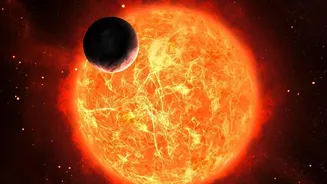
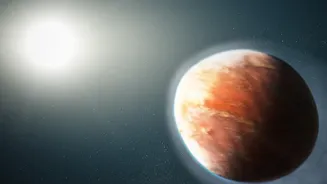
In a major return on its monumental technological investment, the JWST has confirmed the existence of a 'steam world'—a planet with an atmosphere rich in water vapour. The planet, named GJ 9827 d, is located about 98 light-years from Earth and is roughly
twice our planet's size. While earlier observations from the Hubble Space Telescope had hinted at moisture, the power of Webb's instruments has provided a much clearer picture, confirming that the atmosphere is not hydrogen-dominated like a gas giant, but is instead dense with heavier molecules, primarily water. This is a landmark moment; it's the smallest exoplanet to date where such a water-rich atmosphere has been robustly detected, proving that worlds with atmospheric compositions similar to rocky planets exist beyond our solar system.
How Webb 'Sees' an Alien Atmosphere
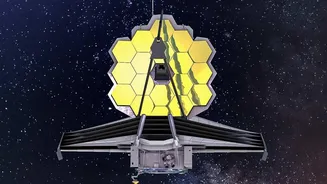
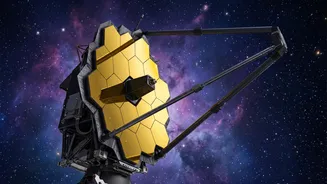
Detecting the chemical makeup of a planet light-years away is a marvel of modern engineering. The technique is called transmission spectroscopy. As GJ 9827 d passed in front of its host star, the JWST's highly sensitive instruments, including its Near-Infrared Imager and Slitless Spectrograph (NIRISS), analysed the starlight filtering through the planet's atmosphere. Different molecules absorb light at specific wavelengths, leaving a unique chemical fingerprint in the light that reaches the telescope. By reading this signature, scientists can determine which gases are present. For GJ 9827 d, the signature of water was unmistakable and abundant, confirming it as the first observed example of a long-theorised steam world.
An Inhospitable, Steamy World
While the presence of water is exciting, GJ 9827 d is no paradise. The planet is scorching hot, with temperatures soaring to around 350-425 degrees Celsius—as hot as Venus. This means the water exists as a thick, oppressive steam rather than liquid oceans. Life as we know it could not survive in these conditions. Researchers have two main theories for its formation. It could be a 'mini-Neptune' that formed farther from its star and migrated inward, its hydrogen atmosphere stripped away by stellar radiation, leaving the heavier water vapour behind. Alternatively, it might have formed closer to its star, a rocky world with a water-rich composition from the start. Either way, it is a fascinating natural laboratory, but not a candidate for habitability.
A Crucial Step for Science
So, if GJ 9827 d is uninhabitable, why is this discovery so important? It's a proof of concept. For years, astronomers have mostly been able to study the hydrogen-heavy atmospheres of gas giants. Detecting atmospheres around smaller, potentially rocky planets has been a huge challenge. This finding proves that the JWST has the power and precision to do just that. It demonstrates that planets with dense, water-rich atmospheres can and do exist, providing a crucial data point for understanding planetary formation. According to scientists involved in the project, this is a significant move toward the ultimate goal of finding and characterising truly Earth-like worlds. It helps astronomers refine what they're looking for and confirms their primary tool is up to the task.
What Comes Next in the Search?
The discovery of GJ 9827 d as a steam world opens a new chapter in exoplanet science. It validates the existence of this type of planet and gives astronomers a template to search for others. The focus will now shift to using the JWST to study other small planets, especially those located in the 'habitable zone' of their stars, where temperatures could allow for liquid water. Having successfully identified a heavy, water-dominated atmosphere, scientists can now apply these methods to worlds that might be more hospitable. This landmark observation is not the final answer in the search for extraterrestrial life, but a critical milestone that sharpens the focus and proves that we finally have the technology to ask the right questions of the cosmos.