



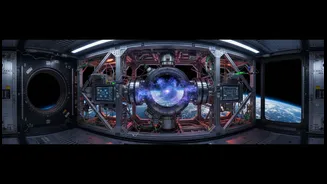


What Exactly Is the Cold Atom Lab?
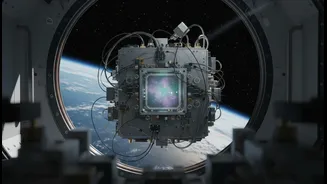
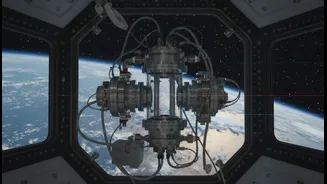
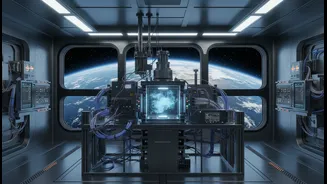
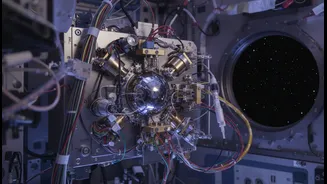
Think of the Cold Atom Lab (CAL) as a high-tech, mini-fridge-sized laboratory designed to be the coldest known spot in the universe. Launched in 2018, its mission is to cool atoms down to a mere fraction of a degree above absolute zero, the theoretical
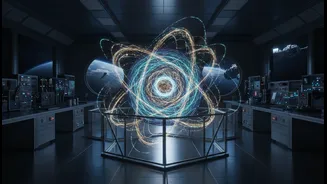
point where all atomic motion ceases. Using a combination of lasers and magnetic fields, CAL slows down clouds of atoms like rubidium and potassium until they reach these ultracold temperatures. At this point, something incredible happens: the atoms lose their individual identities and condense into a single, collective quantum object known as a Bose-Einstein Condensate (BEC), often called the fifth state of matter. In this state, the strange rules of quantum mechanics, usually confined to the subatomic realm, become visible on a macroscopic scale.
Why Does It Have to Be in Space?
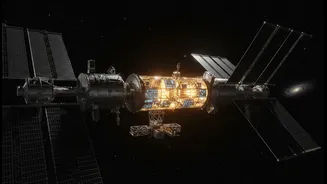
The key to the Cold Atom Lab's power is its location. On Earth, gravity is a constant nuisance for quantum physicists. When scientists create a Bose-Einstein Condensate, gravity immediately pulls the delicate atomic cloud downwards, limiting observation time to mere milliseconds. In the microgravity environment of the International Space Station, it's a different story. Without the strong pull of gravity, these condensates can float freely, allowing them to expand and be observed for much longer periods—up to ten seconds or more. This extended observation time is like a cosmic slow-motion button, giving scientists an unprecedentedly clear and long look at quantum behaviors. This allows for more precise measurements and the potential to observe new quantum phenomena that are simply impossible to see on Earth.
What Have We Learned So Far?
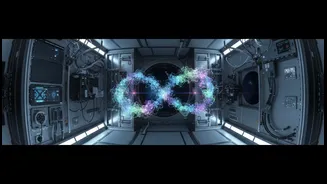
Since its installation, CAL has been a game-changer, successfully creating the first BECs in orbit and enabling multiple international research teams to conduct experiments remotely from Earth. One of the major achievements has been creating bubble-like shapes with the quantum gases, something not possible under Earth's gravity. Recent upgrades, installed in April 2026, have further enhanced its capabilities. A redesigned magnetic trap now allows scientists to actively alter the shape of the quantum gas clouds, stretching and squeezing them to study their properties in new ways. The facility has also successfully produced dual-species quantum gases, which are essential for testing fundamental principles of physics, like Einstein's theory of general relativity, with extreme precision.
The Future of Quantum Technology
The research conducted on the Cold Atom Lab is not just about exploring the weirdness of the quantum world for its own sake. It serves as a crucial pathfinder for a new generation of quantum technologies. The ultra-sensitive nature of cold atoms makes them ideal for creating next-generation sensors. These could lead to advanced navigation systems for spacecraft that don't rely on GPS, allowing astronauts to navigate on the Moon, for instance. They could also be used to build instruments that can precisely map Earth's gravitational fields to monitor climate change, such as tracking the movement of water and the thickness of ice sheets. By pushing the boundaries of what we can do with cold atoms in space, the CAL is laying the foundation for technologies that could revolutionize everything from fundamental science to space exploration and planetary science.