



Your Window to the Past
Here’s the fact: every time you look up at the night sky, you are looking back in time. It sounds like science fiction, but it’s a fundamental reality of our universe. The reason is surprisingly simple: light, though incredibly fast, takes time to travel.
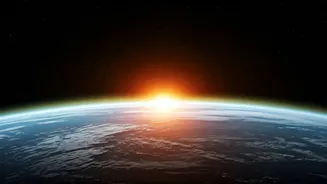
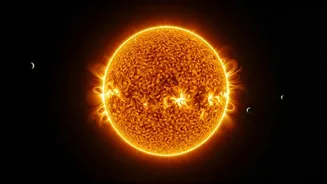
Nothing in the universe travels faster, but the sheer vastness of space means that even at a speed of about 300,000 kilometres per second, the journey from a star to your eyes is a long one. Even the light from our own Sun takes about eight minutes and twenty seconds to reach Earth. This means if the Sun were to suddenly vanish, we wouldn't know about it for over eight minutes. Every sunset we watch is technically an image of the Sun from eight minutes in the past.
A Personal Time Machine
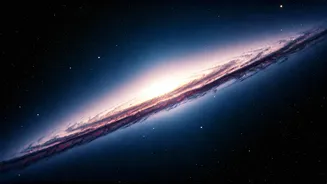
This effect gets more dramatic the farther you look. The closest star system to us after the Sun is Alpha Centauri, whose light takes more than four years to reach our planet. When you see it in the sky, you are viewing it as it was over four years ago. The light from Sirius, the brightest star in our night sky, has been travelling for 8.6 years. Things get truly mind-bending when we look beyond our immediate stellar neighbourhood. The Andromeda Galaxy, the most distant object you can see with the naked eye, is about 2.5 million light-years away. The faint, fuzzy patch of light you see is an image of a trillion-star galaxy as it existed 2.5 million years ago, long before modern humans walked the Earth.
Telescopes as Cosmic Archives
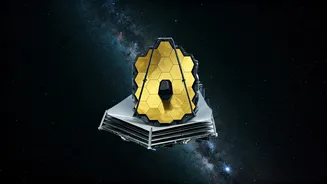
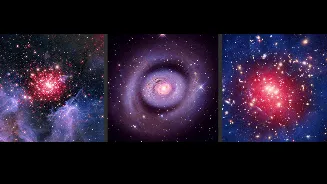
Modern instruments like the Hubble and James Webb Space Telescopes are designed to exploit this principle. They are powerful time machines, built to capture the ancient light from the most distant corners of the cosmos. The James Webb Space Telescope (JWST) can see objects whose light has been travelling for over 13 billion years. Considering the universe is estimated to be about 13.8 billion years old, the JWST is effectively looking at the universe's 'baby pictures'—seeing some of the very first galaxies as they were forming just a few hundred million years after the Big Bang. These aren't just images; they are historical records, allowing scientists to piece together the story of cosmic evolution.
Ghosts in the Sky?
This time-delay effect leads to a fascinating and slightly eerie question: could some of the stars we see in the sky already be dead? The answer is a philosophical and statistical yes. A star's lifespan, while incredibly long, is finite. It's possible that a star hundreds or thousands of light-years away could have exploded in a supernova long ago, but its final burst of light has not yet reached us. From our perspective, the star is still there, shining brightly. However, for the stars visible to the naked eye, this is statistically unlikely. Most are within a few thousand light-years, and stars typically live for millions or billions of years. So, while it’s a captivating thought, the vast majority of the stars you can see are still very much in existence, even if we are seeing their past selves.