




What Exactly is the SKA?
The Square Kilometre Array is a global project to build the world's largest and most sensitive radio telescope. Unlike a traditional optical telescope that uses a single large mirror, the SKA is an array, meaning it combines signals from thousands of
antennas spread over vast distances. This allows it to act like a single, continent-sized dish with a collecting area of one square kilometre, hence the name. The project is split across two locations to cover different radio frequencies: SKA-Low in Western Australia and SKA-Mid in South Africa. With its headquarters in the UK, it represents a massive collaborative effort in science and engineering involving more than a dozen countries.
A Telescope of Two Halves
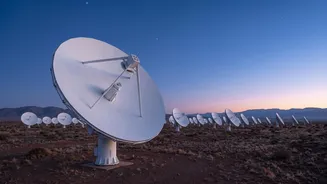
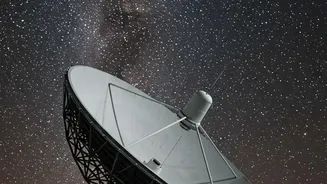
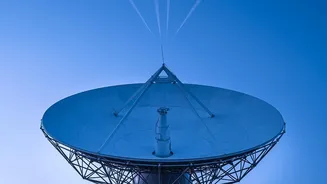
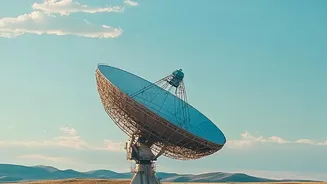
The two sites have distinct but complementary jobs. SKA-Low, located on Wajarri Yamaji Country in Australia, will consist of over 131,000 Christmas tree-shaped antennas. These are designed to pick up low-frequency radio waves. Their primary target is one of the most mysterious periods in cosmic history: the 'Cosmic Dawn' and the subsequent 'Epoch of Reionization'. Meanwhile, SKA-Mid in South Africa's Karoo region will feature nearly 200 large dishes, incorporating the existing 64-dish MeerKAT telescope. SKA-Mid will observe mid-range frequencies to study everything from gravitational waves and pulsars to the potential signatures of life elsewhere in the galaxy.
Listening for the Universe's First Light
The headline's "faint early universe signals" refers to the telescope's most ambitious goal: detecting the 21-cm signal from neutral hydrogen gas. Before the first stars and galaxies formed, the universe was filled with this gas. As these first luminous objects ignited, they began to ionize the gas around them, clearing the cosmic fog. This period is known as the Epoch of Reionization. The signals from this era are incredibly faint and have been stretched by the expansion of the universe over billions of years. SKA-Low is specifically tuned to detect this faint glow, which will allow astronomers to create 3D maps of the early universe and, for the first time, watch the cosmos light up.
An Engine for Discovery and Data
While studying cosmic origins is a primary goal, the SKA's capabilities are vast. It will test Einstein's theories of relativity with extreme precision by timing signals from pulsars, map the structure of the cosmic web, and shed light on the roles of dark matter and dark energy. This unprecedented scientific power comes with a monumental technical challenge: data. The SKA telescopes will generate more data than the entire global internet traffic of today. Processing and storing this flood of information requires custom-built supercomputers on-site and a global network of regional centres, pushing the boundaries of big data technology.
When Will It Start Scanning?
Construction of the SKA officially began in late 2021 and is a multi-year effort expected to be complete around 2029. The headline's use of "Scans" reflects the ongoing progress and early science activities. Precursor telescopes like MeerKAT in South Africa and ASKAP in Australia are already making major discoveries. On the main sites, construction is well underway. The first antennas for SKA-Low were installed in 2024, and by late 2025, 15,000 were assembled. In South Africa, several SKA-Mid dishes are now on site and have achieved 'first fringes'—a critical test where two dishes work together as one. Science commissioning has begun, with the first science data expected to be released to astronomers in 2027 as the arrays continue to grow.