The Violent End of a Sun-Like Star
To understand a second-generation planet, we first need to appreciate the dramatic life cycle of its parent star. Most stars in the Milky Way, including our own Sun, will end their lives as white dwarfs. When such a star runs out of hydrogen fuel, it swells
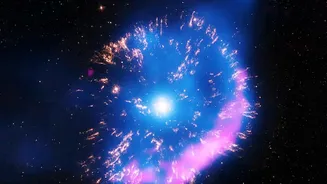
into a massive, fiery red giant. This expansion is catastrophic for any nearby planets, which are often engulfed and destroyed. Eventually, the star sheds its outer layers, leaving behind a scorching, dense core about the size of Earth—a white dwarf. This stellar zombie is all that remains of the once-mighty star and its original planetary system. For a long time, this was seen as the final chapter.
A Phoenix from the Ashes
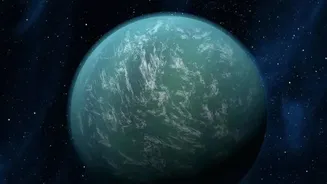
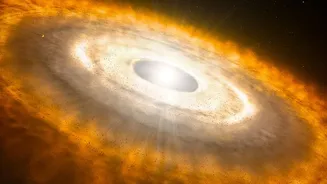
The new discovery suggests that the story doesn't always end there. A second-generation planet is one that forms after the star has died. The theory is that the gas and dust ejected during the star's red giant phase, combined with the debris of any obliterated first-generation planets, can gather into a new disk of material around the white dwarf. Over millions of years, this 'protoplanetary disk' can coalesce and form entirely new worlds. These are not survivors of the original system but true newcomers, born from the wreckage of the old one. It's a cosmic version of a phoenix rising from the ashes.
The Telltale Clues at HS 0209+0832
The focus of this potential discovery is a white dwarf named HS 0209+0832, located about 270 light-years from Earth. When astronomers led by the University of Warwick re-analyzed old data from the Hubble Space Telescope, they found a very strange chemical signature in the white dwarf's atmosphere. White dwarfs are known to 'pollute' their atmospheres by pulling in material from nearby objects. But instead of common rock-forming elements like silicon, HS 0209+0832 was loaded with unusually heavy elements like zinc, copper, and most notably, niobium.
Why Niobium Is the Smoking Gun
The presence of niobium is what makes this case so compelling. This element, found at levels over 1,000 times higher than in our Sun, is not typically created during a star's normal life. Instead, it's forged through a specific nuclear reaction called the 's-process', which happens deep inside a star during its final, bloated red giant phase. Finding this element raining down onto the white dwarf strongly implies that the material came from the star's own ejected guts, not from a pre-existing rocky planet. This unique chemical fingerprint points directly to the planet being a second-generation world, formed from the star's own remains.
More Evidence and Lingering Doubts
Further evidence came from NASA's TESS satellite, which detected a faint, repeating dip in the star's brightness every 4.4 days. This signal is consistent with a Jupiter-sized gas giant orbiting extremely close to the white dwarf, where its atmosphere is likely being boiled away by the intense radiation and pulled onto the star's surface. However, the headline's caution is crucial. This is still a 'possible' planet. The evidence is strong but indirect. Alternative explanations, while less likely, haven't been entirely ruled out. Conclusive proof, such as directly imaging the planet or obtaining more detailed atmospheric data, will require follow-up observations, potentially from powerful instruments like the James Webb Space Telescope. Until then, it remains a tantalizing candidate.