


The Science of the Stillness
How can holding a seemingly simple pose build serious strength? The magic lies in isometric contractions. When you hold a yoga pose, your muscles are engaged and firing, but they aren't changing in length. This sustained tension, known as time under tension, creates
microscopic tears in the muscle fibres, which then repair themselves to become stronger. Unlike crunches that primarily target the surface-level 'six-pack' muscles (rectus abdominis), yoga poses often engage the entire core canister. This includes the deep transverse abdominis which acts like a natural corset, the obliques along your sides, and the muscles supporting your spine. This holistic approach not only builds abdominal strength but also improves posture, enhances balance, and helps prevent lower back pain.
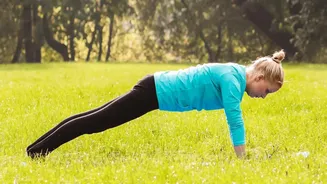
Plank Pose (Phalakasana)
Plank is the quintessential core-strengthening pose for a reason. It requires you to engage nearly every muscle in your body to maintain a straight line from head to heels. To practice, start on your hands and knees, then step your feet back until your body forms a straight line. Your hands should be directly under your shoulders. Actively press the floor away, pull your belly button towards your spine, and engage your leg muscles. Don't let your hips sag or rise too high. For a gentler variation, you can lower your knees to the mat or perform the pose on your forearms. Aim to hold for 20-30 seconds, focusing on steady breathing, and gradually increase the duration as you get stronger.
Boat Pose (Navasana)
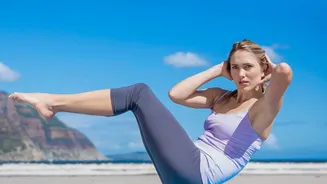
Boat Pose is a fantastic and direct challenge for the abdominal muscles. To begin, sit on the floor with your knees bent and feet flat. Place your hands slightly behind you for support. Engage your core and lift your feet off the floor, bringing your shins parallel to the ground. You can keep your hands behind you for support or, for a greater challenge, extend them forward, parallel to the floor alongside your legs. Keep your chest lifted to avoid rounding your spine. To modify, you can keep your knees bent. To intensify, work on straightening your legs into a 'V' shape. Holding this pose fires up the lower abs and hip flexors, crucial components of core stability.
Bridge Pose (Setu Bandhasana)
While often thought of as a gentle backbend, Bridge Pose is an excellent way to strengthen the posterior chain—the muscles on the back of your body, including your glutes and lower back, which are integral to a truly strong core. Lie on your back with your knees bent, feet flat on the floor hip-width apart, and arms by your sides with palms down. Press into your feet and lift your hips off the floor. Clasp your hands underneath your back and roll your shoulders under to open your chest. Continue to press your hips up, engaging your glutes and hamstrings. This pose not only strengthens but also provides a beneficial stretch for the front of the body.
Bird-Dog Pose (Dandayamana Bharmanasana)
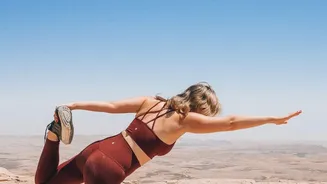
This pose is a brilliant exercise in stability, forcing your deep core muscles to work hard to prevent your torso from rotating. Start on all fours in a tabletop position, with your wrists under your shoulders and knees under your hips. Engage your core to keep your back flat. Extend your right arm straight forward and your left leg straight back, maintaining a level pelvis. Imagine you could balance a cup of tea on your lower back. Hold for a few breaths, then return to the start and repeat on the other side, extending your left arm and right leg. This movement trains the core to maintain balance and stability, which is essential for everyday functional movement.
Chair Pose (Utkatasana)
Chair Pose builds heat and strength throughout the lower body and core. Stand with your feet together or hip-width apart. Inhale and raise your arms overhead. As you exhale, bend your knees and sink your hips back and down, as if sitting in a chair. Your core must work continuously to stabilize your spine and prevent you from leaning too far forward. Keep your weight in your heels and your chest lifted. This pose is a powerful way to build functional core strength that supports your posture throughout the day.