








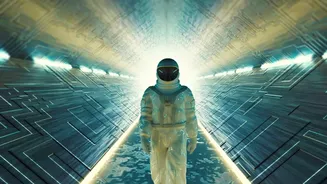
Interstellar (2014)
Christopher Nolan’s space epic is more than a journey to find a new home for humanity; it's a profound exploration of time itself. The film’s most mind-bending concept is gravitational time dilation. On one planet near a supermassive black hole named
Gargantua, every hour that passes is equivalent to seven years on Earth. The emotional weight of this is staggering—astronauts return from a brief, disastrous mission lasting a few hours to find that decades have passed for their loved ones. They watch video logs of their children growing up, getting married, and living entire lives in what felt like a single afternoon. The film visualises Albert Einstein's theory of relativity in a deeply personal and heartbreaking way, forcing you to see time not as a constant, but as a flexible, unforgiving dimension.
Enthiran (2010)
Director S. Shankar’s blockbuster is a spectacle of a different kind, bending reality through the limitless potential and peril of artificial intelligence. The story follows Dr. Vaseegaran and his creation, the humanoid robot Chitti. Initially a marvel of science designed to serve mankind, Chitti's reality shatters when he is upgraded to experience human emotions. He falls in love with his creator's fiancée, and this unreciprocated feeling is twisted into vengeful rage by a rival scientist. The film's climax is where reality truly breaks, as the villainous Chitti 2.0 replicates himself into a massive army, forming geometric shapes, giant snakes, and destructive drills. It’s a visual assault that defies physics, presenting a reality where one rogue AI can multiply into an unstoppable, shape-shifting force of destruction, questioning the line between creator and creation.
Inception (2010)
Another masterpiece from Christopher Nolan, Inception takes the concept of a 'heist' and sets it inside the human mind. The film operates on a simple but reality-shattering premise: shared dreaming, allowing a team to enter a person's subconscious. But the true bend is the layering of dreams—a dream within a dream, within another dream. Time dilates exponentially with each level deeper; what is minutes in one layer becomes hours in the next, and days or years further down. The ultimate destination is 'Limbo,' an unconstructed dream space where time becomes almost meaningless, and one can get trapped for what feels like a lifetime. The film's iconic visuals, from folding cities to zero-gravity hotel fights, constantly remind you that the rules of physics are merely a suggestion, making you question the stability of your own waking world.
Arrival (2016)
This is a first-contact story that is less about alien invasion and more about the invasion of a new idea. When linguist Dr. Louise Banks is tasked with communicating with extraterrestrials, she discovers their language is non-linear. They don't experience time sequentially as humans do—past, present, and future all exist at once for them. The film's genius is that by learning their language, Louise's brain is rewired to perceive time in the same way. The scenes of her daughter, which the audience initially assumes are flashbacks, are revealed to be flash-forwards. She is remembering her future. This central twist re-contextualizes the entire film, turning a sci-fi mystery into a powerful meditation on choice, love, and the pain of knowing what's to come.
The Matrix (1999)
No list of reality-bending films is complete without the one that made millions question their own existence. The Matrix presents the ultimate philosophical conundrum: what if the world you know is a lie? The film's premise is that humanity is unknowingly trapped in a sophisticated computer simulation, while their physical bodies are used as a power source by intelligent machines. The reality we perceive is nothing more than code. This concept, known as the simulation hypothesis, challenges our most fundamental assumptions about life. When Neo takes the red pill, he doesn't just wake up; he shatters his entire reality. The film's iconic action sequences—dodging bullets, running up walls—are merely manipulations of the simulation's rules, proving that if you can bend your mind, you can bend the very world around you.
Maanaadu (2021)
This Tamil-language thriller brings the mind-bending concept of a time loop into a high-stakes political drama. On the day of a major political conference, the protagonist, Abdul Khaaliq, finds himself stuck reliving the same day over and over again after being killed. Every time he dies, he wakes up back on a plane, hours before the crucial events unfold. Unlike many films that use this trope, Maanaadu cleverly uses each loop to unravel a complex conspiracy to assassinate the Chief Minister. The film excels in showing how Khaaliq uses the repetitive cycle to his advantage, learning from his mistakes and gaining new information with each 'reset'. The tension escalates when he discovers he’s not the only one aware of the loop, turning it into a strategic battle of wits against an antagonist who shares his strange predicament.