


The Universe’s Hidden Skeleton
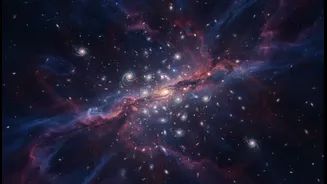
For decades, scientists have theorized that the universe has a vast, underlying structure. It’s not just a random scattering of stars and galaxies in a dark void. Instead, it’s organized by a massive, invisible network known as the “cosmic web.” Imagine
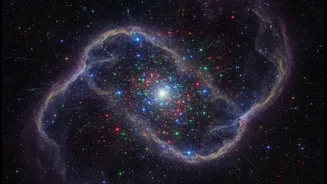
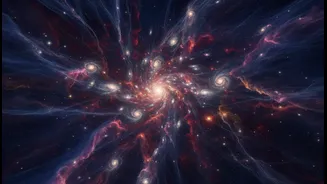
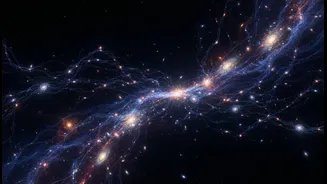
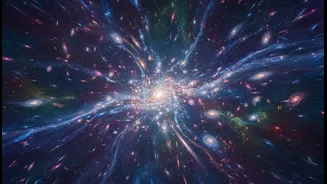
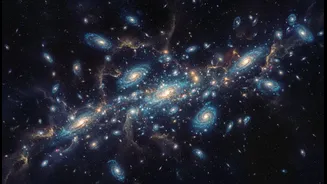
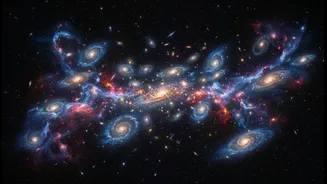
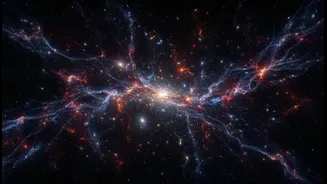
a gigantic, three-dimensional spiderweb stretching across the entire cosmos. The long, thin strands are filaments made of dark matter and hydrogen gas. Where these filaments intersect, matter becomes concentrated, creating the dense hubs where galaxies are born and cluster together. The vast, dark spaces in between are called voids. This web is the skeleton or scaffolding of the universe, dictating the large-scale architecture of everything we see. For most of history, this structure has been largely invisible and theoretical, inferred but not seen. But that is rapidly changing.
A Game-Changing Technological Leap
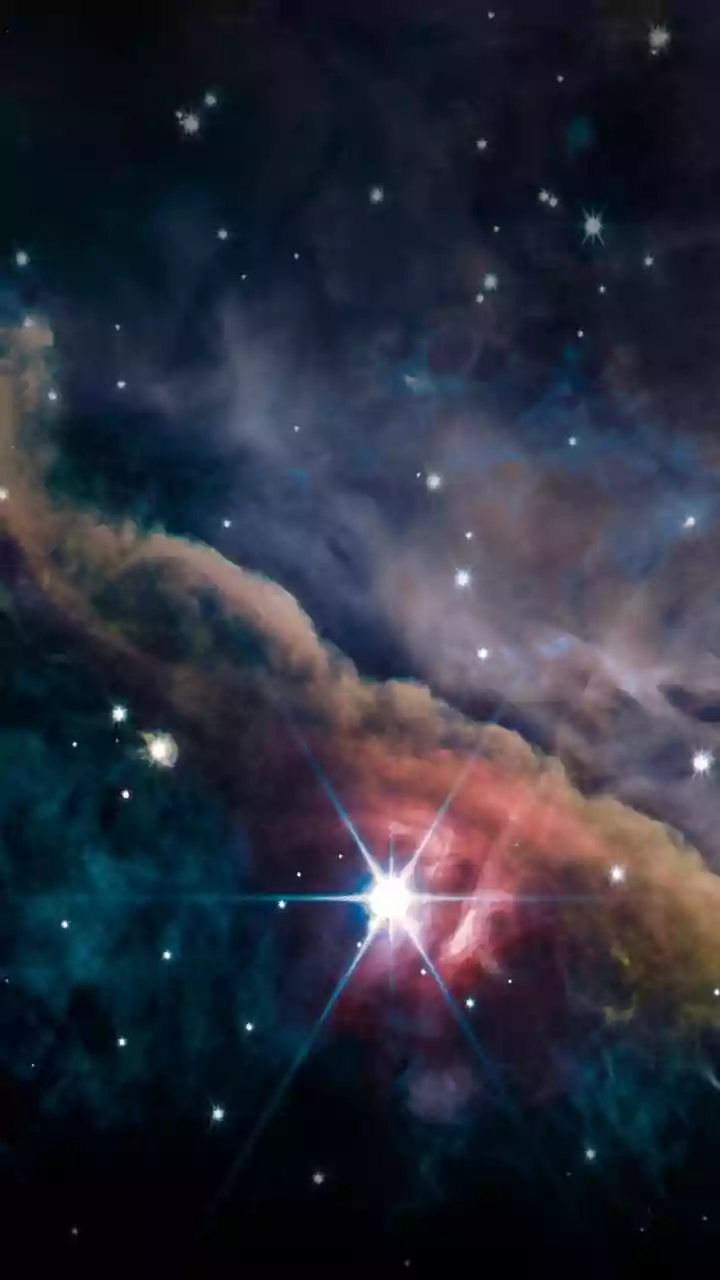
The primary reason this cosmic architecture is suddenly “in your feed” is the James Webb Space Telescope (JWST). Launched in 2021, this observatory represents a monumental leap in our ability to see the universe. While the Hubble Space Telescope gave us iconic images, its view was often limited. In many images, distant structures appeared as blurry blobs. The JWST, operating in the infrared spectrum, can peer through cosmic dust and detect the faint light from the universe's most ancient galaxies. The result is a jump in depth and resolution so significant that astronomers are comparing it to putting on glasses for the first time. What used to be a single, smoothed-over structure now resolves into countless individual points of light and intricate details, allowing scientists to see the cosmic web when the universe was just a few hundred million years old.
Mapping the Cosmic Highways
Armed with this new tool, astronomers embarked on the largest survey yet conducted by the JWST: COSMOS-Web. This ambitious project used hundreds of hours of telescope time to map a patch of the sky about the size of three full moons. The goal was to create the most detailed 3D map of the cosmic web ever assembled, tracing its structure back through 13 billion years of cosmic history. The resulting map, built from the positions of over 164,000 galaxies, provides an unprecedented look at how this network evolved. It shows how galaxies act like cities forming along intergalactic highways, with gas and matter flowing along the filaments to fuel star formation. This process isn't just about birth; the map also shows how dense environments in the web can eventually shut down star formation, causing galaxies to die.
Rewriting the Universal Blueprint
This flood of high-definition data is doing more than just creating pretty pictures. It's actively testing and, in some cases, challenging our fundamental understanding of cosmology. For instance, recent discoveries of enormous structures like the 'Big Ring,' a circle of galaxies 1.3 billion light-years in diameter, defy current models. According to the prevailing cosmological principle, the universe should be roughly uniform on the largest scales, but structures this large shouldn't theoretically exist. Other observations with the JWST show galaxies and galaxy clusters forming much earlier in the universe's history than previously believed possible. These findings don't necessarily break our understanding of physics, but they do show that the process of cosmic construction was perhaps faster and more complex than our previous, blurrier view allowed us to see. We are finding that the universe's construction crew may have been working ahead of schedule.