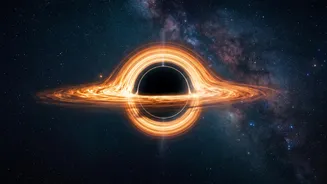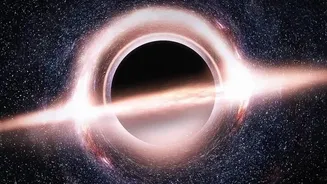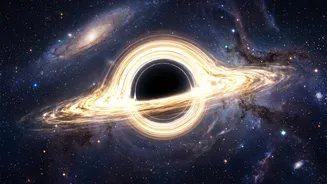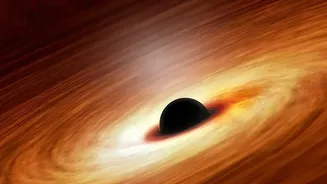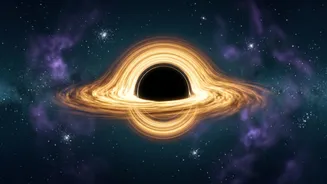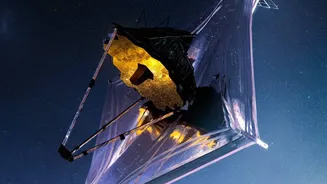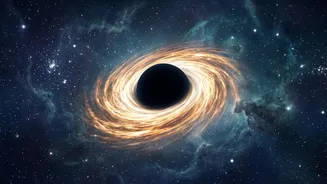


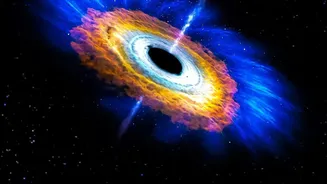
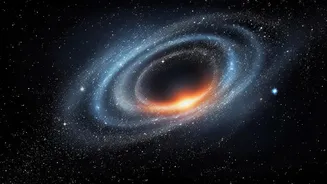
In an age of artificial intelligence and automated discovery, it seems counterintuitive that one of the best tools for finding black holes is the human eye. Yet, that’s the reality for initiatives like Black Hole Hunters.
A Cosmic Needle in a Haystack
Modern telescopes are powerful
instruments, generating an almost incomprehensible amount of data every single day. Surveys like NASA's Transiting Exoplanet Survey Satellite (TESS) monitor millions of stars, measuring their brightness with incredible precision. While these technologies were designed to find distant planets, they also capture other cosmic events. Hidden within this data deluge are clues to some of the universe's most elusive objects: dormant black holes. Astronomers estimate there could be 10 million to 100 million of these stellar-mass black holes in our Milky Way galaxy alone, but only a tiny fraction have been found. Finding them is a monumental task, far too great for professional astronomers to tackle alone.
Why Machines Can't Do It Alone
The go-to solution for analysing massive datasets is typically an automated algorithm or a machine-learning model. These systems are trained to search for specific, pre-defined signals. For black holes, one key signal is a 'self-lensing' event. This occurs when a black hole in a binary system passes in front of its companion star from our point of view. Its immense gravity acts like a magnifying glass, briefly and characteristically making the star appear brighter. The problem is that computers struggle to distinguish these rare, single-peak events from other stellar phenomena or instrumental noise. Automated systems can flag millions of potential candidates, but many are false positives. They lack the nuanced pattern-recognition ability to identify a truly 'interesting' or unusual signal that doesn't perfectly match its programming.
Enter the Citizen Scientist
This is where projects like Black Hole Hunters, hosted on the Zooniverse platform, come in. The initiative turns the overwhelming data problem into a collaborative effort by asking volunteers to become cosmic detectives. No advanced degree in astrophysics is required. Participants are shown graphs of star brightness over time, called light curves, and are asked to identify patterns. They learn to spot the tell-tale symmetrical peak that could indicate a black hole lensing event. By having thousands of people review the data, the project harnesses the power of the human brain's superior ability to recognise subtle patterns and dismiss irrelevant noise, a skill that even sophisticated AI finds difficult to replicate perfectly.
A Powerful Human-Machine Partnership
The Black Hole Hunters initiative isn't about replacing machines but creating a powerful symbiotic relationship. Automated algorithms perform the initial, broad sweep, filtering millions of light curves down to a more manageable number of candidates. Then, the citizen scientists step in to perform the crucial second pass of verification. This human review creates a highquality shortlist of the most promising targets. This allows professional astronomers to dedicate precious and expensive telescope time to follow up on only the most credible signals, confirming whether an unseen companion is indeed a black hole. The classifications from volunteers are also used to train and improve future machinelearning models, making the entire system smarter and more efficient over time.