



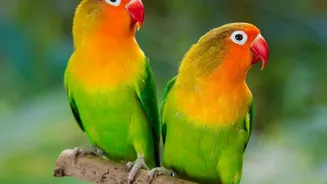
More Than Just Copying
When a parrot mimics a phrase, it’s not just playing back a recording. This ability is a rare skill in the animal world known as vocal production learning. While a few other animal groups, like songbirds, hummingbirds, and dolphins, are vocal learners,
parrots are in a class of their own when it comes to imitating human speech. This isn’t simple imitation; it’s a complex process of hearing a sound, processing it, and then physically recreating it. To do this, parrots use a special vocal organ called the syrinx. By precisely controlling muscles around the syrinx, they can modulate airflow to shape a wide variety of tones, pitches, and sounds that remarkably resemble human words.
A Uniquely Wired Brain
The true secret to the parrot’s talent lies in its brain. Groundbreaking research has revealed that the parrot brain has a unique structure not seen in other birds. Scientists have identified that birds capable of vocal learning have defined centres in the brain for this task, known as 'cores'. Parrots, however, have an additional layer: a set of 'shells', or outer rings, that also play a crucial role in vocal learning. This 'core-and-shell' system is what sets them apart. Studies have shown that parrot species known for being exceptional talkers, like the African Grey, tend to have larger and more developed shell regions. This specialized brain architecture, which scientists believe evolved at least 29 million years ago, gives parrots an enhanced ability to process and reproduce new sounds.
The Drive to Connect
Having the right hardware is only half the story. The other key ingredient is motivation, and for parrots, that motivation is social. Parrots are highly social creatures that, in the wild, live in large, noisy flocks where complex vocal communication is essential for survival. They use calls to bond, find each other, and warn of danger. When a parrot lives with humans, it sees its human family as its flock. Its instinct is to fit in and communicate, so it begins to imitate the sounds of its new flock: human speech. This mimicry is a form of social bonding. They are often drawn to words spoken with excitement or emotion, associating those sounds with attention and interaction.
But Do They Understand Us?
This is the million-dollar question for any parrot owner. Is the bird just mindlessly repeating sounds, or does it grasp their meaning? The answer is more complex than a simple 'yes' or 'no'. While most parrots are primarily mimicking sounds they associate with certain contexts, some have demonstrated a surprising level of understanding. A parrot might learn to say 'Hello' when someone enters a room because it has learned the context, not because it understands the greeting's abstract meaning. However, famous research with an African Grey parrot named Alex showed that some parrots can go much further. Dr. Irene Pepperberg's work with Alex demonstrated that he could learn to identify objects, colors, shapes, and quantities, using human words to answer questions. He wasn’t just mimicking; he was showing referential use of language—understanding that a word refers to a specific thing. While Alex’s abilities were exceptional, they prove that at least some parrots can connect words to their meanings, especially with consistent training and interaction.