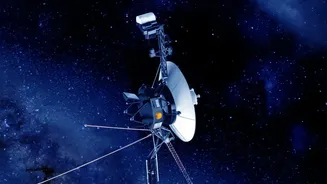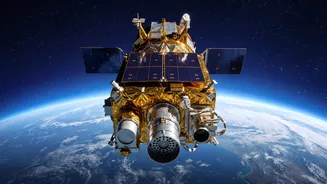








The legendary Hubble Space Telescope, our eye on the universe for over three decades, is in a slow but steady orbital decay. A thrilling proposal to send a commercial mission to its rescue is on the table, but NASA is moving with caution.
An Icon's Fading Orbit
Since its launch
in 1990, the Hubble Space Telescope has transformed our understanding of the cosmos, delivering iconic images like the 'Pillars of Creation'. However, the telescope has no propulsion system of its own. Constant atmospheric drag, a microscopic friction from Earth's upper atmosphere, is causing its orbit to gradually shrink. NASA projects that without intervention, Hubble will make a fiery re-entry into the atmosphere sometime between 2033 and 2034. This inevitable fate, combined with the natural aging of its components like its sensitive gyroscopes which are critical for pointing the telescope, has created a sense of urgency around its future. The last servicing mission by Space Shuttle astronauts was in 2009, and with that program retired, any new house call would require a completely new approach.
A Commercial Lifeline Emerges
The prospect of a private-sector rescue gained significant attention in 2022. A study involving SpaceX and the Polaris Program, led by billionaire entrepreneur Jared Isaacman, explored the feasibility of using a Crew Dragon spacecraft to visit Hubble. The proposal included boosting the telescope to a higher, more stable orbit, potentially adding years to its operational life. This idea represents a major shift, moving from government-led servicing missions of the past to a new model of public-private partnership in space. For commercial companies, such a mission would be a landmark achievement, demonstrating advanced capabilities in rendezvous, docking, and in-space servicing.
NASA's Cautious Exploration
In late October 2026, NASA officially opened the door to these ideas by issuing a formal Request for Information (RFI). This RFI invites commercial space companies to submit their concepts for extending Hubble's life by November 30. It's crucial to understand that an RFI is not a contract or a commitment to a flight. It is a market research tool for NASA to gauge what is technologically possible, what the risks are, and what the potential costs might be. The request outlines three broad possibilities: a reboost mission to a higher orbit, a servicing mission to enhance its capabilities, or a controlled de-orbit to safely dispose of the telescope at the end of its life.
The High_Stakes Calculation
Saving Hubble is not a simple task. The telescope was not originally designed to be serviced by any vehicle other than the Space Shuttle. A commercial spacecraft, like Dragon, would have to perform a complex rendezvous and docking procedure with an object that was not built for it. There are significant risks, including the potential for collision or contamination of Hubble's sensitive optics. Any mission would have to prove it could safely interact with the priceless observatory without causing harm. NASA's recent experience with a failed attempt to rescue the Swift observatory in 2026 serves as a stark reminder of the challenges of robotic servicing missions, highlighting that rendezvous and control are still substantial risks. The agency must weigh the immense scientific reward of extending Hubble's mission against the very real risk of damaging a historic asset.