







Beyond Grammar Checks: The New AI Assistant
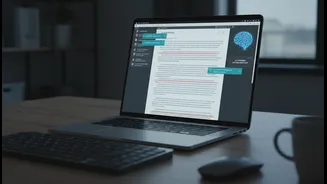
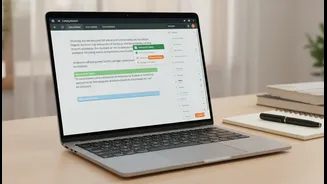
When we talk about AI in research, it's easy to think of tools like Grammarly, which polish grammar and style. But the new generation of AI self-review workflows goes much deeper. These are sophisticated systems designed to engage with the substance of your
work. Think of tools like ChatGPT, Claude, and specialized academic platforms like Kimi Deep Research or NotebookLM. They can help you brainstorm topics, summarize dense academic papers, organize your notes, and even structure the outline for your entire thesis. This process isn't about replacing the researcher but augmenting their abilities. An AI workflow might involve using one tool to gather relevant papers, another to extract key arguments and data from those papers, and a third to help build a coherent narrative structure from your findings. It acts as an tireless assistant that can process vast amounts of information, helping you focus on the most critical part: the thinking.
A Boost for Productivity and Clarity
For student researchers, especially in India, the pressure to produce high-quality work quickly is immense. AI tools offer a significant advantage by automating time-consuming tasks. Instead of spending days on literature reviews, an AI assistant can scan thousands of papers and deliver a synthesized summary with citations in minutes. This speed allows students to dedicate more time to analysis and original thought. Furthermore, these tools can be a great equalizer. For students who may not be native English speakers, AI can help refine language and improve clarity, ensuring their ideas are judged on merit, not on linguistic proficiency. Studies have also pointed to a positive impact on student well-being; by simplifying complex tasks and reducing academic workload, these tools can lower stress levels.
A Companion with Critical Caveats
However, this smart companion comes with its own set of warnings. The most significant risk is accuracy. Generative AI is known to 'hallucinate'—that is, to invent facts, create non-existent publications, and misrepresent data with complete confidence. Relying on it without independent verification is a recipe for disaster. There's also the risk of intellectual laziness. If AI does the heavy lifting of summarization and synthesis, students may not develop the critical thinking skills that come from wrestling with complex texts themselves. The output can also be biased, reflecting the biases present in the vast amount of internet data it was trained on. Finally, over-reliance can lead to a homogenization of thought, where research papers start to sound eerily similar, lacking the unique voice and perspective of the author.
Navigating the Ethical Tightrope
The biggest question hanging over AI use in academia is integrity. When does assistance become plagiarism? In India, the University Grants Commission (UGC) has made its position clear: using AI-generated text without disclosure is considered plagiarism under existing 2018 regulations. While the UGC has not yet released a dedicated AI policy, it has advised universities to develop their own guidelines, emphasizing that the student is always responsible for the final work. Many major Indian institutions like IITs, NITs, and even National Law University Delhi have already updated their policies, often setting limits on the percentage of AI-generated content and mandating full disclosure of which tools were used and how. Submitting a thesis with a low plagiarism score from a tool like Turnitin no longer guarantees safety; universities are now also using AI detection tools that look for patterns in writing style. The key takeaway is transparency.
Best Practices for a Smart Partnership
To use AI as an effective and ethical companion, students must adopt a strategic approach. Think of AI as a brainstorming partner, not an author. Use it to generate ideas, explore different angles, or create a first-draft outline, but never as a replacement for your own intellectual effort. Crucially, you must be the expert in the loop. Always fact-check every claim and verify every citation against the original source. When using AI to summarize, treat the output as a starting point for your own reading, not the final word. Many experts recommend a workflow where you use AI for discovery and organization but take over completely for the critical analysis and writing phases. Disclose your use of AI in line with your university's policy. Acknowledging the tool's role protects your academic integrity.