





The Hunt for Hidden Oceans
For astrobiologists, liquid water is the primary target. Life as we know it depends on it, so NASA’s mantra has long been to “follow the water.” This search has led scientists to develop a kind of blueprint for identifying “ocean worlds”—planets and moons
that harbour significant bodies of liquid water. Traditionally, the search focused on the “habitable zone” around a star, where temperatures are just right for liquid water to exist on a planet's surface. But the discovery of subsurface oceans on icy moons has shattered this concept. Worlds like Jupiter’s moon Europa and Saturn’s moon Enceladus are far outside the sun's traditional habitable zone, yet they are two of the most compelling candidates for alien life. The key is internal heat, generated by the immense gravitational pull of their host planets, which is enough to maintain vast liquid oceans beneath kilometres-thick shells of ice.
Reading the Cosmic Fingerprints
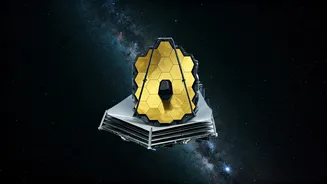
Detecting these hidden oceans requires a diverse toolkit of clever scientific techniques. For exoplanets hundreds of light-years away, telescopes like the James Webb Space Telescope (JWST) use a method called absorption spectroscopy. When a planet passes in front of its star, the starlight filters through its atmosphere. By analysing this light, scientists can spot the unique chemical signature of water vapour. For moons closer to home, the methods are more direct. The Galileo spacecraft first inferred Europa's ocean by measuring disturbances in Jupiter's magnetic field, suggesting a conductive layer of salty water beneath the ice. Missions can also analyse plumes of water vapour erupting from the surface, as the Cassini spacecraft did at Enceladus, essentially sampling the ocean's contents directly. Future missions like the Europa Clipper will use ice-penetrating radar to map these subsurface seas.
Our Solar System’s Prime Suspects
Our own solar system hosts a fascinating collection of potential ocean worlds. Jupiter's moon Europa is a top contender, with strong evidence suggesting a global saltwater ocean that may contain twice as much water as all of Earth's oceans combined. Its surface is a fractured landscape of ice, hinting at the dynamic ocean churning below. NASA's Europa Clipper mission, which launched in October 2024, will perform dozens of close flybys to investigate its habitability. Saturn's tiny moon Enceladus is another prime target. It actively sprays jets of water vapor and ice from deep fissures in its southern polar region. Analysis of these plumes revealed not just water, but also organic molecules and silica grains, suggesting the presence of hydrothermal vents on its ocean floor—the same type of environment that may have supported the first life on Earth.
Beyond Our Cosmic Neighborhood
The James Webb Space Telescope has revolutionized the search for water on exoplanets, discovering water vapor in the atmospheres of numerous distant worlds. Some discoveries hint at the existence of “Hycean” worlds—a theorized type of planet completely covered by a deep, hot ocean with a hydrogen-rich atmosphere. The exoplanet K2-18 b, located 120 light-years away, is a leading candidate, with JWST detecting key atmospheric molecules that suggest a water-rich environment. Other potential water worlds, like Kepler-138 d, are estimated to have a significant fraction of their mass composed of water, far more than Earth's mere 1%. However, interpreting this data can be complex; what appears to be a temperate water world could also be a scorching-hot planet with a dense, steamy atmosphere unsuitable for life.
The Blueprint for Life?
Finding liquid water is a monumental first step, but it doesn't automatically mean a world is habitable. The complete blueprint for life requires three key ingredients: liquid water, essential chemical elements, and a source of energy. On Earth, life thrives at hydrothermal vents on the dark ocean floor, using chemical energy instead of sunlight. The evidence of similar processes on Enceladus is a tantalizing clue. Moreover, scientists now believe that even planets completely covered in a global ocean could remain habitable for over a billion years, challenging earlier assumptions that land-based geological cycles are necessary to stabilize a climate. As our technology advances, the search is no longer just for signs of water, but for the specific combination of conditions that could allow life to begin and thrive in the dark, hidden oceans of deep space.