




The Martian Marathoner
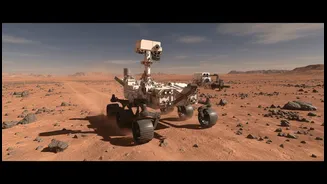
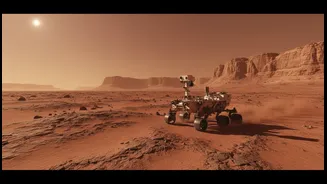
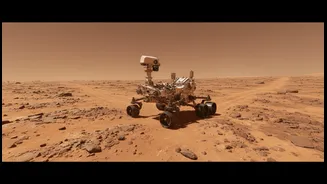
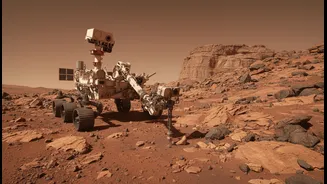
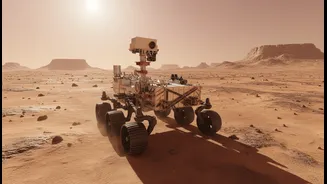
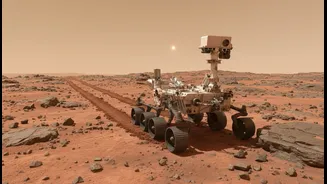
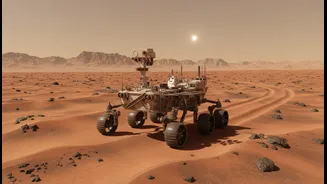
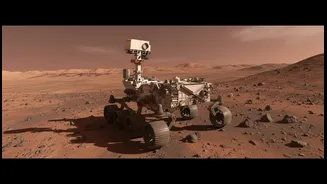
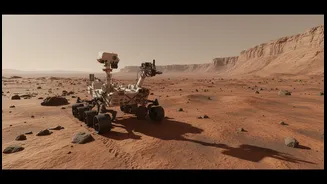
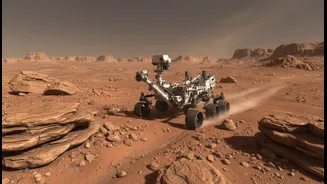
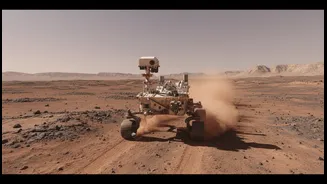
In mid-June 2026, the Perseverance rover officially clocked in a full marathon distance on the Red Planet. This remarkable achievement was accomplished in just over five years, a pace that far surpasses the previous record holder, the Opportunity rover,
which took more than 11 years to cover the same ground. This enhanced speed and endurance are not for sport; they are critical for the rover's primary mission: searching for signs of ancient life in Mars' Jezero Crater. By covering more territory more quickly, Perseverance can analyze more geological features and collect a wider variety of rock and soil samples for a potential future return to Earth, dramatically increasing the mission's scientific output.
A Rover That Thinks for Itself
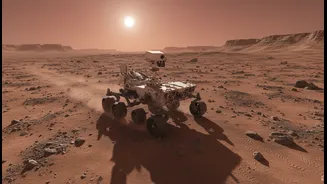
The secret to Perseverance’s impressive pace is its advanced autonomous navigation system, known as AutoNav. Unlike its predecessor, Curiosity, which had to stop, take images, and analyze them before moving, Perseverance can essentially “think while driving.” It uses a dedicated second computer brain that processes images and maps the terrain in real-time, identifying hazards like large rocks or sand traps and planning routes around them without constant input from human controllers back on Earth. This allows the rover to navigate complex landscapes more efficiently and safely. In recent demonstrations, NASA has even used artificial intelligence to generate waypoints for the rover, further pushing the boundaries of autonomous exploration on other worlds.
Built for the Long Haul
Long-duration mobility isn't just about smart software; it also requires robust hardware. Perseverance is powered by a Radioisotope Thermoelectric Generator (RTG), a nuclear power source that gives it a potential lifespan of over a decade, far exceeding the two-year primary mission. This power system is not reliant on solar panels, which can be compromised by dust storms that block out the sun. Engineers at NASA's Jet Propulsion Laboratory have also conducted extensive durability tests on Earth using a rover twin, certifying that critical components like the wheel actuators can support many more years of exploration. While the rover doesn't perform self-repair, its autonomous systems constantly monitor its own health, from power levels to temperature, ensuring it operates safely and efficiently.
The Main Caveat: Getting Lost
For all its advanced intelligence, the main caveat limiting Perseverance's truly independent long-distance travel is a surprisingly human-like problem: knowing exactly where it is. Mars has no GPS network. The rover primarily relies on a technique called visual odometry, comparing images as it moves to estimate its position. However, tiny errors in this calculation accumulate over distance. The farther the rover drives autonomously, the greater its uncertainty about its precise location becomes. If this uncertainty grows too large, the rover will automatically stop, believing it might be too close to a hazard, and wait for new instructions from Earth. This communication cycle takes time, limiting how far the rover can confidently travel in a single Martian day. While new onboard localization technology is being tested to address this, position uncertainty remains the key bottleneck preventing even longer, faster autonomous drives.