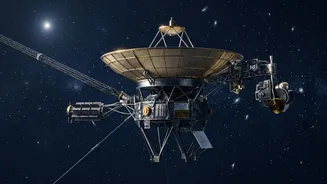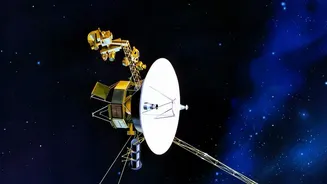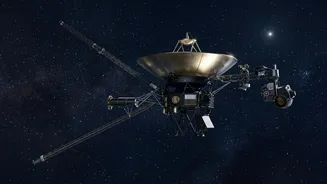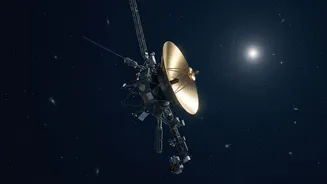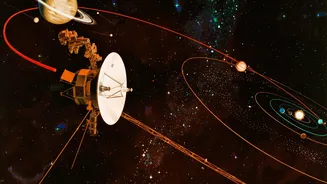



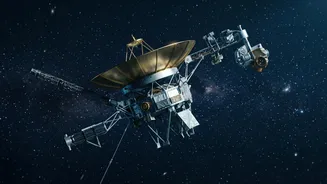
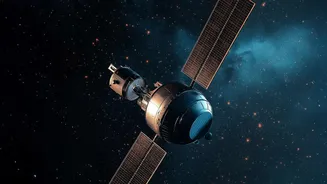
Humanity's farthest emissary, the Voyager 1 spacecraft, is approaching a milestone that stretches the imagination. After nearly 50 years of silent travel, it will soon be one light-day from Earth, a testament to enduring curiosity and ingenuity.
Putting a Light-Day in Perspective
So, what
does it mean to be a 'light-day' away? It's a measure of distance, not time. It represents how far a beam of light travels in a vacuum in 24 hours. That distance is a staggering 25.9 billion kilometres (or about 16.1 billion miles). To put that into context, light from the Sun takes a mere eight minutes to reach Earth. A radio signal sent to Voyager 1 on November 18, 2026, will not arrive until November 19. Any reply would take another full day to travel back. This milestone, which Voyager 1 is expected to cross on November 18, 2026, marks the first time any object built by humans has ventured so far that our own cosmic speed limit, light itself, requires a full day to catch up.
A Grand Tour and Historic Firsts
Launched on September 5, 1977, just 16 days after its twin, Voyager 2, the probe's original mission was to study Jupiter and Saturn. Taking a faster, more direct route, Voyager 1 arrived at Jupiter in 1979, discovering the planet's faint rings and the first active volcanoes beyond Earth on its moon, Io. A year later, it flew past Saturn, providing breathtaking high-resolution images of its complex ring system and dense atmosphere. Following its successful planetary encounters, its mission was extended. In 1998, it officially became the most distant human-made object, surpassing the Pioneer 10 probe. Then, in August 2012, it achieved another historic first: it crossed the heliopause, the boundary where the Sun's stream of particles gives way to the interstellar medium, truly entering the space between the stars.
A Fading Whisper From the Void
Keeping a nearly 50-year-old spacecraft operational from billions of kilometres away is an unparalleled feat of engineering. The probe is powered by radioisotope thermoelectric generators, which convert heat from decaying plutonium into electricity. That power supply dwindles by about four watts each year, forcing NASA engineers to make difficult decisions about which instruments to keep running. In recent years, engineers have skillfully troubleshooted major communication glitches, including one in 2023 that had the probe sending back gibberish for months. As of late 2026, only two science instruments remain active, listening to the hum of interstellar space. Communication with Voyager 1 is expected to cease entirely around 2036, when its power source will be too weak to send a signal back to Earth.
A Message in a Cosmic Bottle
Beyond its scientific instruments, Voyager $carries$ a message:$ the Golden Record.$ This gold $plated$ copper phonograph record is a time capsule intended for any intelligent extraterrestrial life that might one day encounter the spacecraft.$ Assembled by a committee led by famed astronomer Carl Sagan,$ it contains $1$## images,$ a variety of natural sounds from Earth (like wind,$ thunder,$ and whale songs), musical selections from numerous cultures,$ and spoken greetings in $55$ languages.$ It also includes a printed message from then-$U$.S.$ President Jimmy Carter and the brainwaves of writer Ann Druyan as she contemplated Earth's history and the feeling of falling in love.$ The record is a portrait of humanity,$ a symbolic handshake across the cosmos.