



A Sweet Find in a Cosmic Cloud
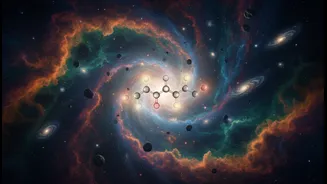
In a remarkable breakthrough announced in mid-July 2026, an international team of astronomers detected erythrulose, a four-carbon sugar, floating in the interstellar medium. The discovery was made in a dense and chilly molecular cloud of gas and dust
known as G+0.693-0.027, located near the supermassive black hole at the heart of our Milky Way galaxy. Using powerful radio telescopes in Spain, scientists identified the unique radio signature of the sugar molecules. While other organic molecules have been found in space before, this marks the first confirmed detection of a true sugar—a molecule with at least three carbon atoms—in the vast expanse between stars. This finding confirms that the building blocks for complex biological molecules are not just present in meteorites but are actively forming in the cosmic nurseries where stars and planets are born.
What is Erythrulose?
On Earth, erythrulose is a simple sugar, or monosaccharide, found in small amounts in red berries like raspberries. It is perhaps best known commercially as an ingredient in sunless tanning products. But in the context of astrobiology, its significance is immense. Sugars are fundamental to life as we know it. They are a primary source of metabolic energy for cells, and, most importantly, they form the structural backbone of nucleic acids. Deoxyribose sugar forms the spine of DNA, and ribose sugar does the same for RNA. Erythrulose, being a four-carbon sugar, is a close chemical cousin to these essential biological components. Its presence in space suggests that the raw materials for life's most critical machinery could be far more common in the universe than previously thought.
Solving an Origin-of-Life Puzzle
For decades, scientists have grappled with a major question in prebiotic chemistry: how did the first sugars form on a young, barren Earth? While famous experiments have shown that amino acids can form under simulated early-Earth conditions, creating a stable and sufficient supply of sugars has proven much more difficult. Laboratory models often produce a messy, unstable tar with very low yields of useful sugars. This has been a significant weak point in models that assume all of life's ingredients had to be synthesised right here on our planet. The discovery of erythrulose in interstellar space offers a compelling and elegant solution. Instead of being made on Earth, these vital sugars could have been forged in space and delivered to our planet during the 'Late Heavy Bombardment' around four billion years ago, a period when Earth was pummeled by comets and asteroids. This cosmic delivery service would have seeded the young planet with the necessary ingredients, bypassing the problematic step of synthesising them in Earth's primordial soup.
A New Recipe for Cosmic Chemistry
Intriguingly, the discovery also challenges some assumptions about how complex molecules form in space. The prevailing theory was that molecules grew in complexity by sequentially adding one carbon atom at a time. If this were the case, astronomers would have expected to find simpler three-carbon sugars in abundance alongside erythrulose. However, the Spanish-led team found no trace of them, indicating that erythrulose is at least eight times more abundant. New quantum chemical models suggest a different pathway: erythrulose may form more efficiently from the combination of simpler two-carbon molecules, such as glycolaldehyde and ethylene glycol, on the frozen surfaces of interstellar dust grains. This shows that the chemical factory of the cosmos may use more complex and varied recipes than we imagined, capable of building larger molecules directly.
From Stardust to the Genetic Code
The discovery’s final, crucial link to the origin of life lies in what erythrulose can become. In water, ketose sugars like erythrulose can easily change their structure to become aldose sugars, such as threose. This is significant because scientists have proposed that Threose Nucleic Acid (TNA), a structurally simpler analogue of RNA using threose as its backbone, could have been a precursor to RNA in the earliest stages of life. The existence of interstellar erythrulose provides a plausible source for the sugars needed to create TNA, offering a potential step-by-step pathway from a simple sugar forged in a cosmic cloud to the complex genetic systems that underpin all life on Earth. The detection of erythrulose, therefore, is not just the discovery of one molecule; it's the illumination of a potential roadmap to our own existence.