
Venus: Earth's Lost Sibling?
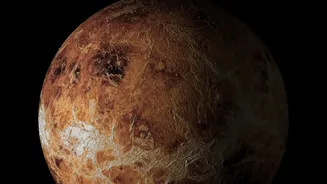
Imagine Earth, but with a runaway greenhouse effect. That's Venus. It's a world with surface temperatures hot enough to melt lead, a crushing atmospheric pressure over 90 times that of Earth's, and thick, swirling clouds of sulfuric acid. Yet, in their
early days, the two planets were remarkably similar, both likely hosting liquid water oceans. So, what went so horribly wrong for Venus? This is one of the most pressing questions in planetary science, and understanding it could offer critical insights into Earth's own climate and future. The answer, scientists believe, is hidden within its mysterious atmosphere and beneath its impenetrable cloud deck.
Enter Shukrayaan: India's Next Giant Leap
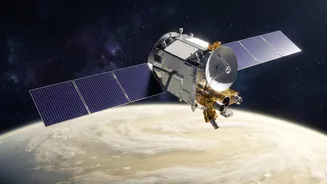
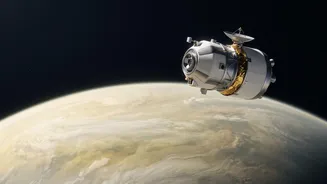
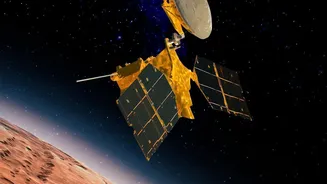
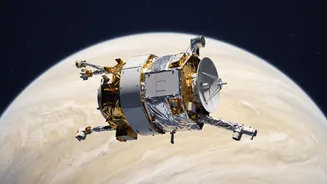
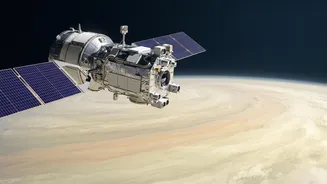
Following the historic successes of the Chandrayaan missions to the Moon and the Mangalyaan mission to Mars, the Indian Space Research Organisation (ISRO) is setting its sights on Venus. The Shukrayaan orbiter, officially the Venus Orbiter Mission, is India's ambitious next step in interplanetary exploration. Approved by the government in September 2024 with a budget of approximately ₹1,236 crore, the mission is scheduled to launch on March 29, 2028, aboard the powerful LVM-3 rocket. After a 112-day journey, the spacecraft is expected to enter a large elliptical orbit around Venus on July 19, 2028. Over the following year, it will use a technique called aerobraking—using the friction of the upper atmosphere to slow down—to settle into a more circular orbit ideal for scientific observation.
The Tools for the Job: A Look at the Orbiter's Eyes
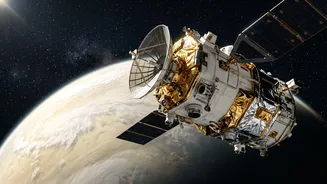
To peer through the thick Venusian clouds, Shukrayaan will be equipped with a suite of sophisticated scientific instruments, or payloads. The orbiter will carry a total of 19 payloads from India and international partners, including Russia, France, Sweden, and Germany. The flagship instrument is a high-resolution Synthetic Aperture Radar (SAR). Unlike optical cameras, radar can penetrate the dense cloud cover to map the planet's surface in great detail, searching for signs of active volcanoes and lava flows. Another key instrument, a first for any Venus mission, is a ground-penetrating radar designed to map the subsurface. Other sensors will focus on the atmosphere itself. The Venusian Neutrals Analyser (VNA), a collaboration with Sweden, will study how the solar wind interacts with the planet's atmosphere, which could explain how Venus lost its water. An instrument co-developed with France and Russia, known as VIRAL, will analyze the atmospheric chemistry.
Peering Through the Veil: The Secrets of the Clouds
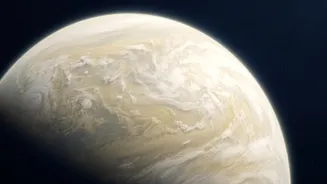
Venus's atmosphere holds many secrets. One major mystery is the phenomenon of 'super-rotation,' where the atmosphere whips around the planet in just four Earth days, far faster than the planet's own 243-day rotation. Shukrayaan's sensors will study wind speeds and cloud movements to understand the forces driving this extreme weather. Another puzzle is the 'unknown UV absorber'—mysterious dark patches in the clouds that absorb huge amounts of solar radiation. For decades, scientists have debated what this substance could be, with some recent studies suggesting it may be a combination of iron-bearing minerals like rhomboclase and acid ferric sulfate. By studying the chemical composition of the clouds, Shukrayaan will provide crucial data to help solve this long-standing puzzle and better understand the energy dynamics of Venus's climate.
Beyond Science: The Strategic Importance
A successful Shukrayaan mission will do more than just answer scientific questions. It will solidify India's position as a major force in global space exploration, capable of undertaking complex, cost-effective interplanetary missions. The extensive international collaboration, with payloads from multiple European space agencies, underscores India's growing role as a trusted partner in space science. For a fraction of the cost of similar missions by other space agencies, ISRO is not only pushing the boundaries of science but also inspiring a new generation of engineers and researchers in India. Following its triumphs at the Moon and Mars, a successful voyage to our 'evil twin' will complete a trifecta of planetary exploration and demonstrate India's expanding capabilities in the final frontier.