






In the vast, frozen landscapes of the Arctic, survival is an art form. Few creatures master it as beautifully as the arctic fox, an animal that performs a remarkable costume change twice a year, swapping its entire coat to match the seasons.
A Master of Disguise
The arctic
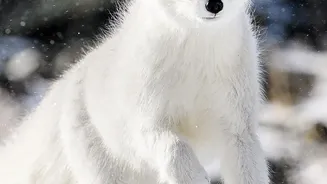
fox (Vulpes lagopus) is a small but incredibly resilient mammal, perfectly adapted to one of Earth's harshest environments. Its most famous trait is its stunning seasonal camouflage. In winter, it is a vision in white, its coat blending seamlessly with the snow and ice. Come summer, as the tundra sheds its snowy blanket, the fox transforms, donning a brown or grey coat to melt into the rocky, plant-strewn terrain. This ability to change colour is not just a neat trick; it is a fundamental strategy for both hunting and hiding in a world of stark contrasts.
A Tale of Two Coats
The difference between the fox's summer and winter attire is dramatic. The winter coat is pure white, long, and exceptionally thick. It is considered one of the warmest pelts of any mammal, providing such effective insulation that the fox can withstand temperatures plummeting to -50°C. This dense, multi-layered fur is about 200% thicker than its summer version, trapping air to keep the animal warm and blurring its outline against the snow. In contrast, the summer coat, which appears after the spring moult, is shorter, thinner, and coloured with shades of brown and grey to match the thawed landscape.
The Science of the Switch
You might assume this incredible transformation is triggered by the cold, but the primary cue is actually sunlight. The change is controlled by what is known as the photoperiod—the length of daylight. As the days shorten in autumn, the fox's brain receives these light signals, triggering a hormonal cascade. The pineal gland increases production of melatonin, which in turn influences the hair follicles to stop producing melanin (the pigment responsible for colour) and grow the new, thick, white winter coat. As the days lengthen in spring, the process reverses, and the thinner, pigmented summer fur grows in.
Survival's Ultimate Tool
For the arctic fox, camouflage is a matter of life and death. In winter, the white coat allows it to become nearly invisible to predators like polar bears, golden eagles, and wolves. It also gives the fox a crucial advantage when hunting. It can sneak up on prey such as lemmings, which are a primary food source. These foxes have such acute hearing they can detect rodents moving in tunnels beneath the snow. They then perform a characteristic high-pounce, diving headfirst into the snow to catch their hidden meal. In summer, the brown fur provides the same advantage, breaking up the fox's outline against the rocks and sparse vegetation of the tundra.
More Than Just Camouflage
While colour is key, the arctic fox's adaptations go far beyond its coat. Its entire body is a marvel of evolutionary engineering for cold climates. It has a compact, rounded body shape, a short muzzle, and small, thick ears to minimize heat loss. Even the soles of its feet are covered in thick fur, acting like natural snow boots that provide insulation and traction on the ice. The fox's long, bushy tail serves as a warm blanket, which it can wrap around itself for extra insulation while sleeping.
The 'Blue' Exception
Interestingly, not all arctic foxes turn white. A small percentage, known as the 'blue' morph, have a different genetic makeup. These foxes have a dark, charcoal-grey or bluish-brown coat in winter, which lightens only slightly from their darker summer fur. This variation is not random; it is more common in coastal and island habitats, such as in Iceland and Greenland, where rocky shores and less consistent snow cover make a dark coat a more effective year-round camouflage. In some coastal regions, this blue morph can actually be the dominant type.