



The Universe’s Standard Story
For decades, astronomers have operated with a standard model of the universe’s history. This model, known as Lambda-CDM, tells a story of gradual evolution. After the Big Bang, the universe was a hot, dense soup of particles. Over hundreds of millions
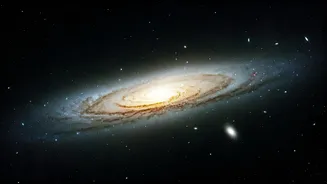
of years, gravity slowly pulled matter together, forming the first small, primitive stars and galaxies. These small structures would then merge and grow over billions of years into the grand, complex galaxies we see today, like our own Milky Way. The key word has always been ‘gradual.’ The expectation was that the very early universe would be full of small, messy, and undeveloped galactic toddlers.
The Telescope's Unexpected Discoveries
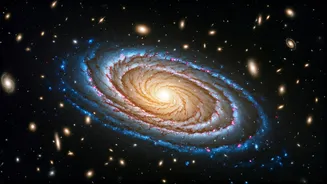
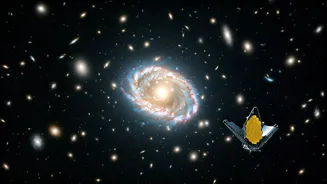
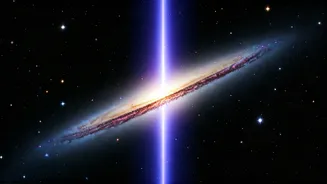
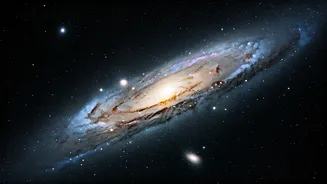
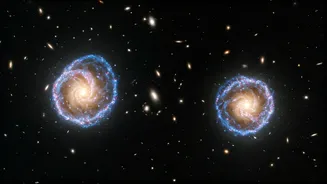
The JWST, however, is showing us a different picture. Almost immediately after it began operations, it started finding objects that defied these expectations. Astronomers are seeing galaxies that are shockingly massive and well-structured at a time when they were supposed to be small and chaotic. For example, a galaxy nicknamed the 'Big Wheel' was found to exist just two billion years after the Big Bang, with a mass several times that of the Milky Way and a beautiful, ordered spiral structure that models suggested shouldn't exist so early. Even more stunning was the discovery of JADES-GS-z14-0, a bright, large galaxy seen when the universe was only about 290 million years old—roughly 2% of its current age. These aren't just galaxies; the telescope is also spotting supermassive black holes in the early cosmos that appear far too large to have grown so quickly.
A Major Cosmic Puzzle
These findings present a major puzzle for astrophysicists. It's like looking at cosmic baby photos and seeing fully grown adults. The presence of such mature structures so early in time challenges the timeline of galaxy formation. Did galaxies grow much, much faster than we thought? Or were the initial 'seeds' of cosmic structure, laid down shortly after the Big Bang, much larger than predicted? Finding mature, 'dead' galaxies that have already stopped forming stars in an early galaxy cluster called the 'Cosmic Vine' only deepens the mystery. These galaxies, seen just 1.8 billion years after the Big Bang, had already lived and died, a process that was thought to take much longer. This forces scientists to question fundamental assumptions about how quickly galaxies can form stars and then cease their star-forming activity.
Rewriting the Cosmic Rulebook
Scientists are now scrambling to adjust their models to fit this new, surprising data. This doesn't mean the Big Bang theory is broken, but it does mean our understanding of what happened afterward needs significant revision. One idea is that star formation was far more efficient in the early universe, allowing galaxies to bulk up quickly. Another possibility is that the very first generation of stars were much more massive than stars today, living short, brilliant lives that rapidly enriched their galaxies with heavy elements. Some researchers are also exploring whether our estimates of galaxy mass are being thrown off by the intense light from voraciously feeding black holes at their centers, making them appear brighter and more massive than they truly are. Others even suggest that our fundamental model of cosmology might need tweaking, perhaps pointing to alternative theories of gravity.