





As winter settles in, finding simple yet effective indoor workouts becomes a priority. The humble step-up is a powerhouse for lower-body strength, but its true benefits lie in mastering the balance and coordination it demands.
More Than Just Lifting a Leg
At its core, the step-up
is a functional exercise that mimics everyday movements like climbing stairs. It involves placing one foot on an elevated surface—like a sturdy bench, box, or even the bottom step of a staircase—and pushing through that leg to lift your entire body. This single-leg (unilateral) movement is fantastic for building strength in your quadriceps, glutes, and hamstrings. More importantly, it challenges your body's stability, forcing smaller stabilising muscles around your hips, knees, and ankles to work overtime. This makes it an excellent tool for identifying and correcting strength imbalances between your left and right sides.
The Intricate Dance of Balance
Balance is not just about staying still; it's a dynamic process managed by your nervous system. It relies on a concept called proprioception—your body's awareness of its position in space. Tiny sensors in your muscles, tendons, and joints constantly send information to your brain about joint angle, muscle stretch, and pressure. During a step-up, the moment you lift your back foot, your body is thrown into an unstable, single-leg stance. Your brain must instantly process signals from your standing leg and core to make countless micro-adjustments, preventing you from toppling over. Your core muscles, including your abdominals and obliques, act as a crucial anchor, stabilising your trunk to create a solid foundation for the movement.
Coordination: Making it All Work Together
Coordination is the brain's ability to command multiple muscle groups to work together smoothly and efficiently. A successful step-up requires a precise sequence of actions: the glutes and quads of the lead leg must fire to extend the hip and knee, lifting you upwards. Simultaneously, the hip stabiliser muscles (like the gluteus medius) prevent your pelvis from dropping to one side, and your core remains braced. The downward phase is just as important. Instead of just dropping, a controlled descent requires eccentric strength, where your muscles lengthen under tension to lower you safely back to the start. This coordinated effort is what turns a simple step into a highly effective exercise.
How to Perform the Perfect Step-Up
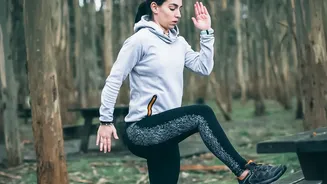
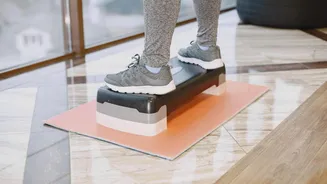
To get the full balance and coordination benefits, form is everything. Start with a low, sturdy platform, roughly knee-height or lower. 1. Stand facing the step, feet hip-width apart. Keep your chest up and core engaged. 2. Place your entire right foot firmly onto the centre of the platform. 3. Drive your weight through your right heel and mid-foot to lift your body straight up. The power should come from this lead leg, not from pushing off your back (left) foot. 4. Bring your left foot to meet your right on the step, standing tall at the top. 5. To descend, step back with your left foot first, landing softly, followed by your right foot. Control the movement rather than letting gravity do the work. Complete all repetitions on one side before switching to the other to maximise muscle fatigue and stability training.
Common Mistakes to Avoid
Several common errors can undermine the benefits of stepups and increase injury risk. The most frequent is pushing off the back foot, which takes the load off the working leg. Another is using a step that is too high, which can force you to lean too far forward or compromise knee stability. Watch out for your knee caving inward on the lead leg ; this often signals weakness in the gluteus medius . Finally , avoid dropping down from the step . The controlled lowering phase is a critical part of the exercise that builds strength and control.
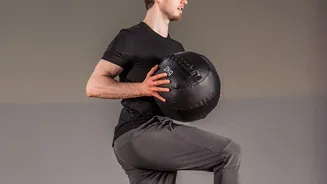
Once you have mastered the basic bodyweight stepup , you can increase the challenge to further improve your balance and coordination . One way is to add a knee drive at the top , lifting the non - working knee towards your chest . You can also progress by increasing the height of the step , as long as you can maintain perfect form . Adding weights , such as holding dumbbells in each hand , will also significantly increase the stability demand on your core and legs . For a pure balance challenge , try performing the exercise more slowly , focusing on a three - second count for both the upward and downward phases .