






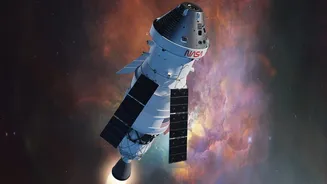
Artemis: A New Era on the Moon
First on the list is the monumental Artemis program. This isn't just about planting another flag; it's about building a sustainable human presence on the Moon to prepare for future journeys to Mars. Following a successful uncrewed test flight and the crewed Artemis II
mission that flew around the Moon in April 2026, the next steps are even more ambitious. Artemis III, planned for 2027, will involve testing the commercial human landing systems from partners like SpaceX and Blue Origin in Earth orbit. The first crewed lunar landing of this new era is targeted for 2028 with Artemis IV. The plan is to establish a regular cadence of missions, creating a foundation for a permanent lunar outpost. This long-term presence will allow for unprecedented scientific research and the testing of technologies crucial for sending astronauts to Mars.
Europa Clipper: Searching for a Hidden Ocean
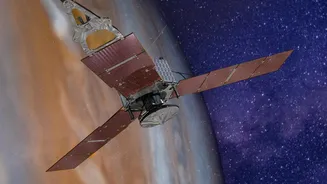
One of the most tantalizing questions in science is whether we are alone in the universe. NASA's Europa Clipper mission is designed to take a significant step toward answering that question. Jupiter's moon Europa is believed to harbor a vast liquid water ocean beneath its icy shell, potentially containing twice as much water as all of Earth's oceans combined. While not a life-detection mission itself, Europa Clipper will perform dozens of close flybys, some as low as 25 kilometers, to investigate whether this hidden ocean has the right conditions for life. Launched in October 2024 and arriving in the Jupiter system in 2030, its suite of instruments will map the ice shell, confirm the ocean's existence and depth, and even analyze plumes of water vapor that might erupt into space. The findings will be crucial for understanding the potential for life on other ocean worlds.
Dragonfly: A Drone on an Alien World
Perhaps one of the most innovative missions ever conceived, Dragonfly will send a car-sized robotic drone to Saturn's largest moon, Titan. Titan is a fascinating world with a thick atmosphere, rivers, and lakes of liquid methane and ethane, and complex carbon-rich chemistry. It’s seen as a prebiotic laboratory, where scientists can study the kinds of chemical processes that may have led to life on Earth. Scheduled for launch in July 2028 and arriving in 2034, the Dragonfly rotorcraft will fly from one location to another, covering more distance than any previous surface mission. It will land at various sites to drill samples and analyze them, searching for the building blocks of life. This mission represents a new paradigm in planetary exploration, allowing for detailed investigation of diverse geological settings on another world.
The Quest for Martian Samples
Bringing a piece of Mars back to Earth has been a long-standing goal for planetary scientists. While NASA's ambitious Mars Sample Return (MSR) mission was reset due to budget and timeline concerns in early 2026, the objective remains a high priority. The Perseverance rover has already collected dozens of compelling rock and soil samples in Jezero Crater, a location that once held a lake and river delta. While the original plan to retrieve them is on hold, NASA is evaluating new, potentially commercial-led architectures to complete the mission. In the meantime, the international community is also pushing forward. Japan's Martian Moons eXploration (MMX) mission, set to launch in late 2026, aims to collect a sample from Mars's moon Phobos and return it to Earth by 2031, which would be the first sample returned from the Martian system. These efforts underscore a global commitment to analyzing Martian materials in advanced labs on Earth.