



A Sweet Discovery Near the Galactic Centre
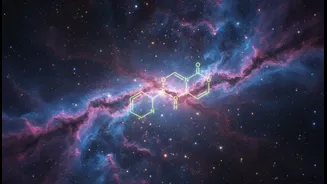
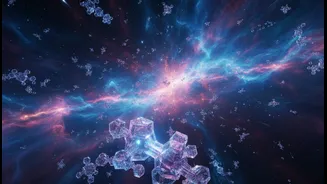
An international team of astronomers has made a landmark discovery: the direct detection of a sugar molecule called erythrulose in the interstellar medium. Using powerful radio telescopes in Spain, they peered into a massive, chemically rich molecular
cloud named G+0.693−0.027, located about 26,700 light-years from Earth near the bustling centre of our Milky Way galaxy. There, amidst the cosmic dust and gas, they identified the distinct radio signal, or “fingerprint,” of erythrulose. While simpler organic molecules are regularly found in such stellar nurseries, finding a true sugar of this complexity is a first, pushing our understanding of cosmic chemistry into new territory.
Why This Sugar Is a Big Deal
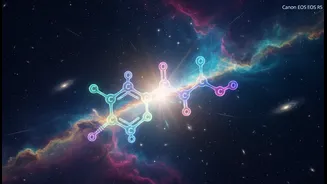
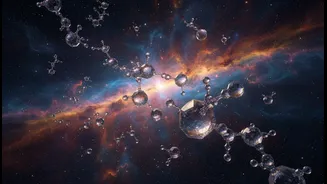
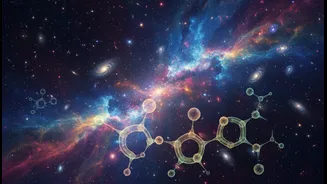
Erythrulose isn't just any molecule; it is a four-carbon sugar, making it significantly more complex than the simpler two-carbon sugar-like molecules previously detected in space. With a structure of 14 atoms, it represents the largest non-cyclic molecule ever identified between the stars. Its discovery is profound because sugars are fundamental to life as we know it. They act as energy sources and, most critically, form the structural backbone of RNA and DNA. The presence of erythrulose confirms that such complex, life-sustaining molecules can form and survive in the harsh, cold environment of deep space, long before planets even begin to coalesce around a star.
A Cosmic Recipe for Life's Ingredients
This discovery also challenges existing theories about how complex molecules form in space. Scientists were surprised to find that erythrulose appears to be at least eight times more abundant than its simpler three-carbon sugar cousins, which remain undetected in the same cloud. This suggests that complex molecules might not always be built one carbon atom at a time. Instead, it seems erythrulose could be formed more efficiently by combining larger, two-carbon molecules on the icy surfaces of interstellar dust grains. Furthermore, erythrulose is a chiral molecule, meaning it can exist in left- and right-handed forms, a key property of the molecules that make up life. It is only the second chiral molecule ever detected in the interstellar medium, adding another layer to its significance.
From Stardust to a Habitable Planet
The detection of interstellar erythrulose strongly supports the theory of an 'exogenous origin' for life's building blocks — the idea that these crucial components were not made on Earth, but delivered here. In aqueous environments, erythrulose can transform into other sugars that are central to the formation of ribose, the 'R' in RNA. Scientists speculate that during the Late Heavy Bombardment period around four billion years ago, comets and asteroids could have delivered millions of tonnes of these space-faring sugars to a young Earth. This cosmic seeding event may have supplied the primordial oceans with the raw chemical inventory needed to kickstart the first biological processes.