


The Challenge of Living off the Land
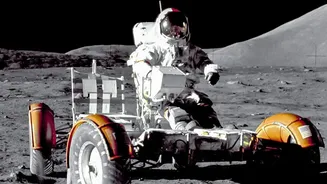
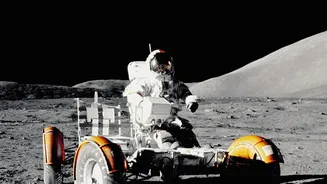
Establishing a permanent base on the Moon isn't like a weekend camping trip. For short Apollo-era visits, astronauts could bring all the oxygen, water, and food they needed in their spacecraft. But for a long-term habitat, this model is unsustainable.
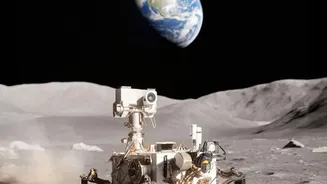
The cost and complexity of launching every last drop of water and breath of air from Earth are astronomical. To truly live and work on the Moon for extended periods, future explorers under the Artemis program need to master the art of 'in-situ resource utilization' (ISRU), a technical term for living off the land. This means harvesting and processing local materials to create essentials like breathable air, water, and even rocket fuel. It’s the single most important factor in transforming the Moon from a temporary outpost into a sustainable stepping stone to the rest of the solar system.
Mining the Moon for Air
At first glance, the Moon appears to be a barren, airless world. But its surface is covered in a layer of fine dust and crushed rock called regolith, and this material holds a surprising secret. Lunar regolith is made of about 45% oxygen by weight. The catch is that this oxygen is not free-floating; it’s chemically locked away inside oxide minerals, the same way oxygen is bound within rust on Earth. To make it breathable, astronauts need a way to break those strong chemical bonds. NASA scientists and engineers are developing and testing several methods to do just that, effectively 'mining' the lunar soil for the air they will need to breathe. This process is a cornerstone of NASA's plan to create a self-sufficient presence on the Moon.
How to Crack a Moon Rock
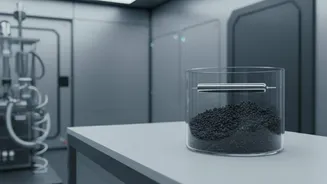
There are two primary methods being developed to liberate oxygen from regolith. The first, and most mature, is carbothermal reduction. In this process, regolith is heated to extremely high temperatures—over 1,600 degrees Celsius—in a reactor. At these temperatures, a carbon source like methane is introduced, which bonds with the oxygen in the minerals to create carbon monoxide (CO). This gas can then be collected, and a subsequent process separates the oxygen from the carbon. Recent experiments, like NASA's Carbothermal Reduction Demonstration (CaRD), have successfully used simulated solar energy to power this reaction, proving that sunlight can be used to generate oxygen on the Moon. The second promising method is molten oxide electrolysis. This process also heats the regolith until it becomes a molten liquid. Then, an electric current is passed through it, much like the electrolysis of water. The current splits the molten oxides, causing oxygen to bubble up at one electrode (the anode) while molten metals collect at the other (the cathode). This not only produces oxygen but also valuable metallic byproducts that could be used for construction.
From Lab to Lunar Surface
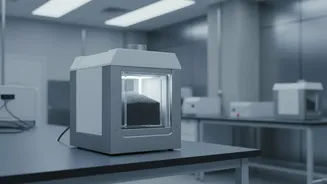
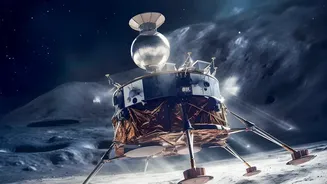
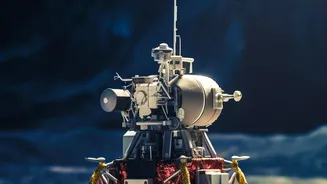
These groundbreaking experiments are rapidly moving from Earth-based laboratories to flight-ready hardware. NASA and its commercial partners, like Sierra Space, have built and tested prototype reactors in vacuum chambers that simulate the lunar environment. At Johnson Space Center, engineers are subjecting hardware to punishing tests against abrasive lunar dust simulant to ensure the machinery can survive on the surface. The CaRD project, for example, successfully integrated a solar concentrator, reactor, and gas analysis systems to prove the solar-powered concept works as an end-to-end system. The Mass Spectrometer Observing Lunar Operations (MSOLO) instrument, a key device for detecting the gases produced, has already been validated on the Moon, demonstrating the readiness of this critical technology. These demonstrations are crucial for retiring risk and gaining confidence before sending a full-scale oxygen plant to the Moon.
More Than Just Breathing
The ability to produce large quantities of lunar oxygen has implications that go far beyond just life support. Oxygen is a major component of rocket propellant, specifically as an oxidizer for fuel like liquid hydrogen. Producing oxygen on the Moon means future rockets could refuel there instead of hauling all their propellant from Earth for a round trip. This would dramatically reduce the launch mass of missions heading to Mars and other deep-space destinations, effectively turning the Moon into a cosmic gas station. It’s a game-changing capability that lowers costs and extends the reach of human exploration across the solar system. The very same soil that astronauts walk on could soon provide the air they breathe and the fuel for their journey onward.