
A Treasure Map for the Moon
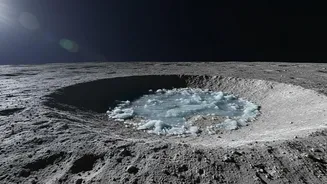
For decades, scientists have theorized that water ice could be hiding in the frigid, permanently shadowed craters of the lunar poles. While past missions have found compelling evidence, new high-resolution maps are transforming the search. These maps,
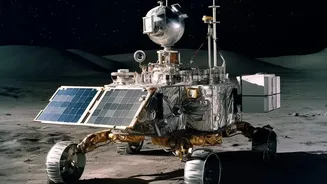
compiled from data gathered by sophisticated neutron spectrometers, move beyond educated guesses to provide a detailed guide to hydrogen-rich deposits. For mission planners at space agencies like ISRO and NASA, this is the equivalent of a treasure map. It pinpoints specific areas where water ice is most likely to be located, turning a vast, barren landscape into a set of promising targets for future robotic and human explorers.
How to Find Water from Orbit
Finding water on a celestial body hundreds of thousands of kilometres away requires some clever science. The key tool is the neutron spectrometer. Think of it as a high-tech dowsing rod that works from space. The Moon is constantly bombarded by high-energy particles from deep space called galactic cosmic rays. These rays smash into the lunar soil, sending a spray of subatomic particles, including neutrons, back into space. A neutron spectrometer measures the energy of these escaping neutrons. This is where it gets interesting: if those neutrons pass through a material rich in hydrogen—the 'H' in H₂O—they slow down significantly. An instrument detecting a large number of low-energy neutrons is a tell-tale sign that there is hydrogen, and therefore likely water, buried just below the surface.
Why 'Accessible' Is the Magic Word
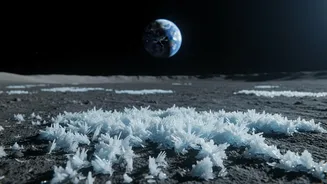
The existence of water is one thing; being able to get to it is another. Much of the Moon's water is thought to be in permanently shadowed regions, some of the coldest places in the solar system where temperatures can plummet below -250 degrees Fahrenheit. Mining in such extreme conditions is a monumental engineering challenge. The significance of the new spectrometer maps is their ability to identify accessible water ice. This refers to ice that isn't at the bottom of a deep, dark crater but is buried just a few centimetres to a metre below the surface in more reachable areas. This shallowly buried ice is protected from being vaporized by direct sunlight and lost to space, but it's still within the grasp of a rover equipped with a drill or a scoop. This distinction makes all the difference between a theoretical resource and a practical one.
Water: The Moon's Black Gold
Finding water on the Moon is not just about quenching the thirst of future astronauts. Water is the single most important resource for creating a self-sustaining presence beyond Earth. Besides providing drinking water, it can be broken down into breathable oxygen. But its most valuable application is in the creation of rocket fuel. By splitting water molecules (H₂O) into their constituent parts—hydrogen and oxygen—the Moon could effectively become a refuelling station in space. Launching mass from Earth is incredibly expensive; every kilogram of water or fuel adds millions to a mission's cost. Being able to produce propellant on the Moon would slash the cost and complexity of space exploration, opening the door for more ambitious missions to Mars and the outer solar system.
Fuelling a New Lunar Race
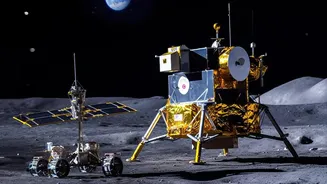
This discovery arrives at a critical time. A new international space race is underway, with the lunar south pole as its primary destination. NASA's Artemis program aims to land astronauts there, with the explicit goal of establishing a long-term presence. Similarly, India's Chandrayaan program and a joint Japanese-Indian mission called LUPEX are focused on exploring this strategic region. These new maps of accessible water are not merely academic exercises; they are vital strategic documents. They will be used to select the safest and most resource-rich landing sites, guiding the next generation of rovers and astronauts. By pinpointing the location of the Moon's most valuable resource, these spectrometer maps are laying the groundwork for humanity's next giant leap.