



The Sleeping Giant
A supermassive black hole (SMBH) is the largest type of black hole, with a mass that can be millions or even billions of times that of our Sun. Nearly every large galaxy is thought to host one at its center. A black hole is considered 'dormant' or 'quiescent'
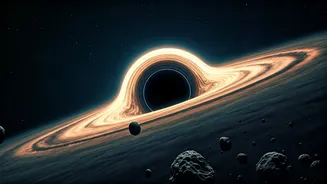
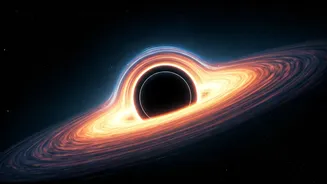
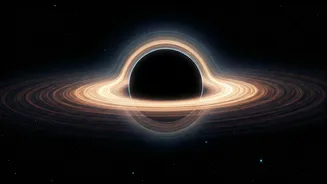
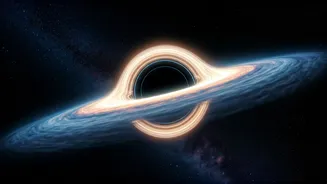
when there is no material nearby for it to consume. Contrary to popular imagination, black holes are not cosmic vacuum cleaners that suck everything in. Matter can maintain a stable orbit around them for a very long time. When a black hole is not actively 'feeding', its accretion disk—a swirling vortex of gas and dust that heats up and emits radiation—dissipates, and the giant goes dark. Its presence can then only be inferred by the gravitational pull it exerts on nearby stars.
The Great Awakening
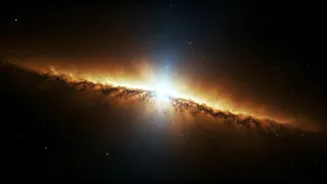
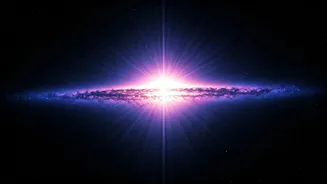
The transition from a dormant to an active state happens when a black hole begins to feed again. As gas, dust, or even a star gets drawn in by the immense gravity, it forms a new accretion disk. The friction within this rapidly spinning disk heats the material to millions of degrees, causing it to glow intensely across the electromagnetic spectrum, from X-rays to radio waves. This energetic phase transforms the galactic core into an Active Galactic Nucleus (AGN), one of the most luminous phenomena in the universe. In some cases, powerful jets of matter are also launched from the black hole's poles at near-light speeds.
A Star on the Menu
One of the most dramatic ways a black hole can awaken is through a 'tidal disruption event' (TDE). This occurs when a star wanders too close and the black hole's immense tidal forces overwhelm the star's own gravity, shredding it apart. This process is sometimes referred to as spaghettification. A portion of the star's debris is flung out into space, but the rest is captured into an orbit, forming an accretion disk that fuels a brilliant, but relatively short-lived, flare of activity. These events, once only theoretical, are now regularly observed by astronomers, providing a unique window into the behavior of otherwise dormant black holes. Recently, astronomers have even observed a black hole repeatedly feeding on the same star, which survived its initial encounter.
When Galaxies Collide
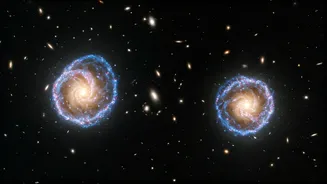
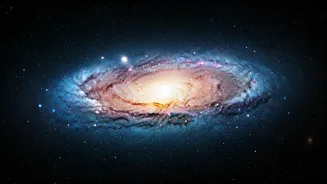
Another major trigger for black hole activation is a galactic merger. When two galaxies collide, the gravitational chaos can funnel vast amounts of gas and dust toward their respective centers. This provides a massive supply of fuel for the supermassive black holes lurking there. As the two galaxies merge, their central black holes will also begin a long process of spiraling toward each other, eventually combining in a cataclysmic event that releases gravitational waves. This process of hierarchical galaxy formation, where larger galaxies grow by merging with smaller ones, is believed to be a primary driver of black hole growth and activity throughout the history of the universe.
A Surprising Flicker
For a long time, scientists believed the transition from dormant to active was a process that took thousands of years. However, recent discoveries of so-called 'changing-look' AGN have upended this view. These are black holes that have been observed to switch between active and inactive states in a matter of just months or years. While the exact mechanisms are still being debated, it suggests that the process of 'turning on' can be far more rapid than previously thought. The study of these flickering giants is a new and exciting frontier in astrophysics, challenging existing models of how accretion disks behave and how black holes interact with their host galaxies.