






The First Responder of the Cosmos
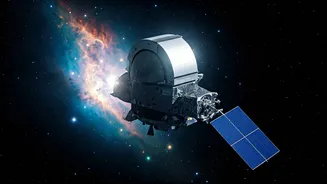
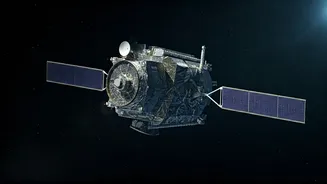
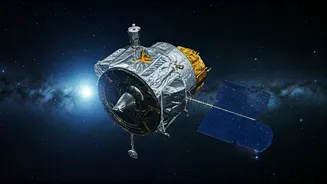
The telescope in question is the Neil Gehrels Swift Observatory. Launched in 2004 for a two-year mission, Swift has far outlasted its original design, operating for over two decades. Its specialty isn’t taking pretty pictures, but acting as a cosmic emergency
service. Swift is uniquely designed to rapidly detect gamma-ray bursts (GRBs) — the most powerful explosions in the universe, often caused by collapsing stars or colliding neutron stars. When a GRB happens, it can last for just a few seconds. Swift can automatically detect one and pivot its X-ray and ultraviolet telescopes towards the event in under a minute, capturing crucial data and alerting astronomers worldwide to do the same. This rapid-response ability makes it an irreplaceable tool for studying fleeting, high-energy events.
A Problem of Gravity and Drag
So, what’s the problem? Swift is in a low-Earth orbit, and after 20 years, its altitude has been steadily decreasing. The issue has been made worse by recent increases in solar activity. Our sun goes through an 11-year cycle, and at its peak, it heats Earth’s upper atmosphere, causing it to expand. This expanded atmosphere creates more drag on satellites like Swift, pulling them down faster. The observatory is now getting dangerously close to an altitude where its fall will become unstoppable, leading it to burn up in the atmosphere. To slow the decay, NASA has already shut down its science instruments to reduce drag, but this is only a temporary fix. Without intervention, the telescope is expected to be lost by the end of the year.
The Audacious Robotic Rescue
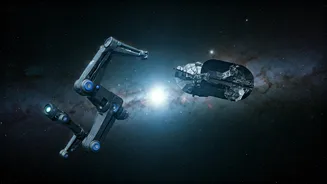
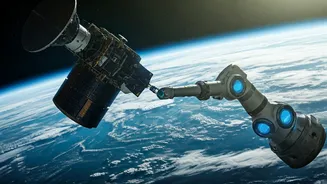
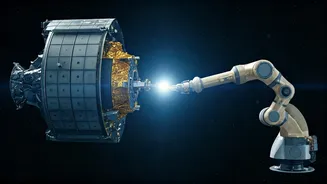
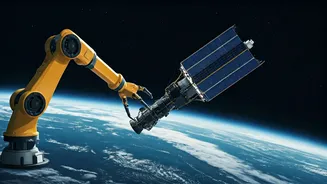
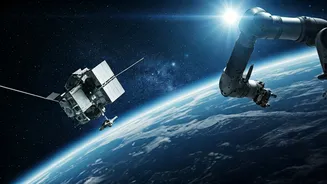
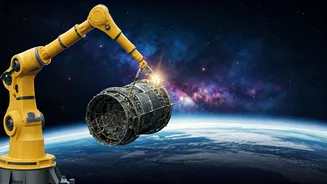
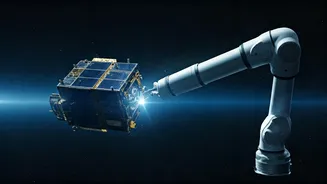
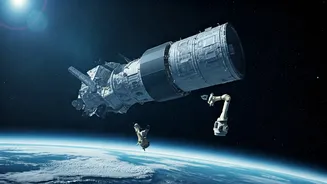
NASA’s plan is to give the telescope a push. The agency has partnered with a US startup, Katalyst Space Technologies, for a $30 million mission to boost Swift back into a higher, more stable orbit. The plan involves a custom-built robotic spacecraft named LINK. In a highly unusual launch method, a Pegasus rocket carrying LINK will be dropped from a jet at high altitude before igniting and heading to space. The LINK robot will then spend about a month tracking Swift down. Once it rendezvous with the telescope, its three robotic arms will carefully grab onto it. This is particularly tricky because Swift was never designed to be captured or serviced in space. Engineers don't even have a clear picture of what the back of the telescope looks like, where the robot must attach itself.
Why This Mission is a Game-Changer
If LINK successfully latches on, it will use its own engines to slowly push Swift about 300 kilometres higher over several months, extending its life for years to come. The stakes are incredibly high. NASA officials have estimated the chances of success at “maybe 50-50.” However, the alternative is the complete loss of a $250 million observatory that cannot be quickly replaced. Beyond just saving Swift, this mission is a crucial test case. If a commercial company can successfully rescue a government satellite that wasn't designed for it, it could revolutionize how we manage assets in space. It could pave the way for future missions to refuel, repair, or reposition other valuable satellites and telescopes, like the Hubble, transforming them from disposable tools into serviceable, long-term observatories.