






What Are Brown Dwarfs?
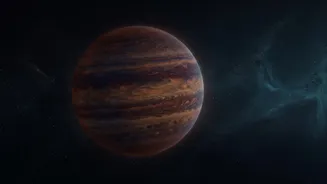
First, let's get acquainted with these mysterious objects. A brown dwarf is a substellar object, more massive than Jupiter but less massive than the smallest stars. Their mass is not sufficient to kickstart and sustain the nuclear fusion of hydrogen in their
cores, which is the process that makes stars like our Sun shine brightly. They do, however, generate some heat from their formation and can briefly fuse a heavier form of hydrogen called deuterium early in their lives. Because they don't have a stable internal furnace, brown dwarfs cool down and become fainter as they age, making them incredibly difficult to spot against the vast, dark backdrop of space. They are the ultimate cosmic middle-ground, bridging the gap between the largest gas giants and the tiniest stars.
The Problem with Visible Light
If you were to look for a brown dwarf with a standard optical telescope, you'd most likely see nothing at all. The name 'brown dwarf' is actually a misnomer; they aren't brown. To the human eye, they might appear magenta or deep red, but most are so cool and dim that they emit very little, if any, light in the visible spectrum our eyes can see. The heat they do radiate is primarily in the infrared part of the spectrum, which is invisible to us. Relying on visible brightness to find them is like trying to find a black cat in a coal cellar at midnight. As they cool over billions of years, any initial visible glow fades completely, leaving only an infrared signature. This is why for decades after they were first theorized in the 1960s, none were actually found.
Seeing the Heat: The Infrared Solution
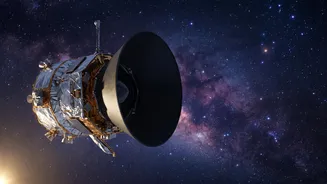
The key to unlocking the secrets of brown dwarfs was the advent of powerful infrared telescopes. Instruments like NASA's Spitzer Space Telescope, the Wide-field Infrared Survey Explorer (WISE), and now the James Webb Space Telescope (JWST) can detect the faint heat these objects radiate. These telescopes operate in the infrared wavelengths where brown dwarfs 'shine' the brightest. By surveying the sky in infrared, astronomers can pick out the faint, warm glow of brown dwarfs from the cold background of space. This has allowed them to discover thousands of these objects, revealing that they are a common, if well-hidden, component of our galaxy. Recent findings from telescopes like SPHEREx are now analyzing thousands more, mapping their complex, cloudy worlds.
Reading an Atmospheric Barcode
Simply detecting a warm spot isn't enough. To truly understand a brown dwarf—its temperature, age, and composition—scientists use a technique called spectroscopy. This involves breaking the object's infrared light down into its constituent wavelengths, creating a 'spectrum' that looks a bit like a barcode. Different molecules in the brown dwarf's atmosphere absorb light at specific wavelengths, leaving dark lines in the spectrum. For cooler brown dwarfs (known as T and Y types), the presence of strong absorption lines from methane and water vapor is a dead giveaway. In fact, the first confirmed brown dwarf, Gliese 229B, was identified in 1995 by the clear signature of methane in its atmosphere—a feature not seen in main-sequence stars.
The Modern Detective's Toolkit
Modern astronomy combines multiple methods. Scientists look for the tell-tale wobble in a star's motion that indicates the gravitational pull of a massive, unseen companion—a technique that can reveal brown dwarfs in orbit. But the game-changer has been the James Webb Space Telescope (JWST). Its incredible sensitivity allows it to not only find extremely cool and low-mass brown dwarfs, some only a few times the mass of Jupiter, but also to analyze their atmospheres in unprecedented detail. JWST has detected hydrocarbons and other complex molecules, challenging existing models of how these 'failed stars' form and evolve. It has even spotted brown dwarfs so cool and faint they were initially mistaken for extremely distant galaxies, highlighting just how elusive these objects can be.