

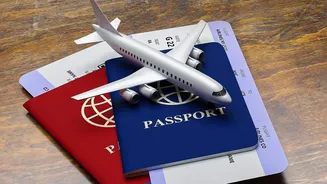
India's government has significantly simplified its visa regime for international visitors, consolidating numerous categories into a more streamlined framework. This overhaul aims to make travelling to India for business, tourism, or study easier than
ever.
A Simplified Two-Step Rationalisation
In a major move to make its visa system more user-friendly, India has consolidated its visa framework in a two-phase process. Initially, the government reduced the main visa categories from 22 to 13 in October 2025. A second round of simplification announced on August 27, 2026, further cut the main categories down to nine. The number of sub-categories has also been drastically reduced from 63 to just 23. According to the Ministry of Home Affairs (MHA), the goal is to create a system that is more 'compact, coherent and responsive' to the needs of foreign nationals. In addition to reducing categories, the application forms themselves have been shortened by 65-70%, a change intended to save time for applicants and allow for more focused scrutiny by officials. The new, streamlined system is expected to be fully operational by the end of 2026 as IT systems are updated.
Introducing the 'Visitor Visa'
One of the most significant changes is the rebranding of the 'Tourist Visa' to the more encompassing 'Visitor Visa'. This reflects a broader range of permissible activities beyond conventional sightseeing. The Visitor Visa is split into two sub-categories. The V-1 visa is designed for short-term stays of up to 30 days with multiple entries, covering activities like brief business meetings, medical consultations, wellness retreats, and short courses in arts or languages. For those planning longer stays, the V-2 visa is available with a validity of one, five, or ten years, depending on eligibility. It covers all activities permitted under V-1 and also includes mountaineering.
What Are the Nine New Categories?
The revised framework organises all travel purposes under nine primary visa headings. These are: Business, Diplomatic, Work, Journalist, Medical, Official, Student, Visitor, and Miscellaneous. Each category is tailored to a specific purpose, removing the ambiguity that often existed in the previous, more complex system. For instance, the Business Visa is now split into B-1 for long-term ventures and B-2 for shortterm, contractbased work like conferences or film shoots. Similarly, the Student Visa is divided into S_1 for formal schooling and university education, and S_2 for research, PhDs, and internships. The Miscellaneous visa covers specific cases like persons of Indian origin and their families.
Clearer Pathways for Medical and Student Travel
The new system provides greater clarity for those travelling for medical treatment or education. The Medical Visa framework maintains a distinction between conventional medicine (M_1) and traditional AYUSH systems (M_3). Both visas will now typically be granted for one year with multiple entries, giving patients more flexibility for followup treatments. Corresponding visas (M_2 and M_4) are available for medical attendants. For students, the streamlined S_1 and S_2 categories make it easier to identify the correct visa for their academic pursuits. Foreign students admitted through the government's 'Study in India' portal may be eligible for an e_S1 visa valid for up to five years, aligning with the duration of their course.
Boosting Tourism and Business
This comprehensive overhaul is designed to remove bureaucratic hurdles and encourage more foreign nationals to visit India. By simplifying the application process and clarifying visa types, the government aims to boost tourism, facilitate medical travel, and attract more foreign students and business investment. The MHA stated that it studied the visa systems of developed countries and global standards to inform these changes, ensuring that the new framework is both efficient and clear. By making the first step of the journey—the visa application—a more straightforward experience, India is positioning itself as a more accessible and welcoming destination for all legitimate travellers.