





The Beginning of the End
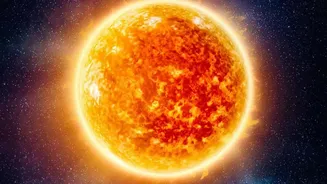
The Sun currently fuses hydrogen into helium in its core, a process that has kept it stable for nearly 4.6 billion years. But this hydrogen fuel is finite. When it runs out, gravity will cause the core to shrink and heat up. This will trigger the fusion
of helium into heavier elements like carbon and oxygen. While the core contracts, the Sun's outer layers will expand dramatically, swelling to hundreds of times its current size and transforming it into a red giant. This phase will mark the beginning of a cataclysmic end for the inner solar system.
A Fiery Fate for the Inner Planets
As a red giant, the Sun's expanding atmosphere will engulf the innermost planets. Mercury and Venus are certain to be vaporized. Earth's fate is less certain but grim. Some models suggest our planet will be swallowed whole. Other studies propose that as the Sun loses mass, its gravitational pull will weaken, allowing Earth's orbit to move outward. Even if it escapes being consumed, the intense heat from the bloated Sun will have long before boiled away our oceans and stripped our atmosphere, leaving behind a scorched, lifeless rock. Mars, being farther out, will likely survive but will be baked by the intense radiation.
A New Dawn for the Outer Worlds
While the inner solar system faces destruction, the Sun's red giant phase will bring a temporary, and strange, 'springtime' to the outer reaches. The habitable zone—the region where liquid water can exist—will shift dramatically outward. Icy moons around Jupiter and Saturn, such as Europa and Enceladus, which are thought to have subsurface oceans, could see their surfaces melt, potentially creating vast liquid water oceans. Saturn's largest moon, Titan, with its thick atmosphere, might warm to conditions resembling early Earth for several hundred million years. Even distant Pluto and other objects in the Kuiper Belt will warm to temperatures similar to Earth's tropics today.
The Final Act and a Chaotic Future
The red giant phase will last for about a billion years before the Sun exhausts its helium fuel. It will then shed its outer layers, creating a beautiful, expanding cloud of gas and dust known as a planetary nebula. At the center will be left a white dwarf—the hot, dense, Earth-sized core of the former star. This stellar remnant will no longer produce new heat, and will slowly cool over trillions of years. The surviving planets, including Jupiter, Saturn, Uranus, and Neptune, will settle into much wider orbits due to the Sun's reduced mass. However, recent studies suggest this new configuration will be far from stable. The violent, uneven process of the Sun shedding its mass could 'kick' the planets into chaotic orbits, leading to collisions or ejections from the solar system within a billion years—a much shorter timeline than previously thought.