


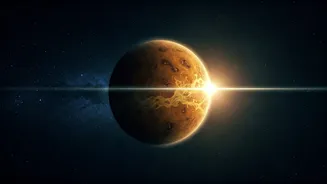


The Clock on Venus Is Broken
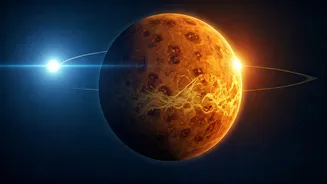
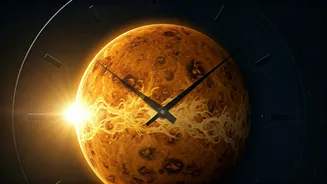
Let’s get the mind-bending numbers out of the way first. A year on Venus—the time it takes to complete one full orbit around the Sun—is about 225 Earth days. By contrast, a single day on Venus, defined as one full rotation on its axis, takes a staggering
243 Earth days. That’s right: a Venusian day is 18 Earth days longer than a Venusian year. This makes Venus the only planet in our solar system with a day longer than its year. If you were standing on its surface, you’d complete a full journey around the Sun before the planet beneath you had even finished spinning once. It’s a concept that breaks our Earth-centric understanding of time, where days are short and years are long.
A Tale of Two Days
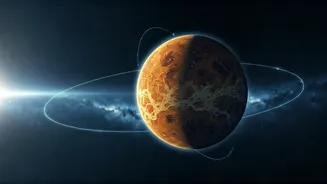
To truly grasp Venus’s weirdness, we need to clarify what a 'day' means. The 243-day figure is a sidereal day—the time it takes for the planet to complete one rotation relative to the distant stars. However, we on Earth usually think in solar days—the time from one sunrise to the next. Because Venus rotates backwards (more on that in a moment), its solar day is different. The combination of its slow rotation and its orbit means that from sunrise to sunrise on Venus is 'only' about 117 Earth days. So, while a sidereal day is longer than a year, a solar day is shorter. This means you’d experience two sunrises for every one trip around the sun. It's confusing, but it’s the core of Venus's bizarre temporal identity.
Spinning the Wrong Way
The plot thickens with Venus's rotation. Unlike Earth and most other planets in the solar system, which spin counter-clockwise on their axis, Venus spins clockwise. This is known as retrograde rotation. If you could stand on Venus and tolerate the crushing pressure and searing heat, you would see the Sun rise in the west and set in the east. Scientists are still debating why Venus is the solar system's odd one out. The leading theory is that it was struck by a massive asteroid or planetoid early in its history, which was so powerful it literally flipped the planet upside down or reversed its spin. Another theory suggests that the gravitational pull of its incredibly thick atmosphere, dragging on the surface for billions of years, could have gradually slowed and then reversed its rotation.
Atmosphere as a Driving Force
Venus's atmosphere isn't just a potential cause of its strange spin; it's a defining feature that creates a hellish environment. It’s 90 times denser than Earth’s and composed almost entirely of carbon dioxide, creating a runaway greenhouse effect. This traps heat so effectively that surface temperatures soar to an average of 465°C—hot enough to melt lead. The thick, soupy atmosphere also features winds that whip around the planet at hundreds of kilometres per hour, a phenomenon called 'super-rotation'. The atmosphere circles the planet in just four Earth days, far faster than the planet itself rotates. This atmospheric drag and tidal effect likely contributes to the planet's slow rotational speed, acting as a constant brake.
A Lesson from Earth's Twin
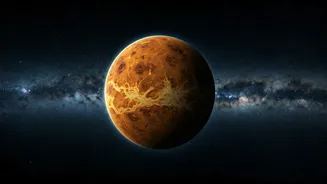
Venus is often called Earth’s twin because of its similar size and mass. But its evolution took a dramatically different path. The long, slow day contributes to this extreme climate. The side facing the Sun bakes for months, while the night side also stays incredibly hot due to the insulating blanket of the atmosphere. There's no cool-down period. The planet’s bizarre timekeeping isn’t just a fun trivia fact; it's a fundamental component of the complex system that turned our sister planet into the most inhospitable world in the solar system. It’s a cautionary tale written in the stars, showing how a few key differences in planetary evolution can lead to a world of fire and acid instead of life.