


The Junkyard in the Sky
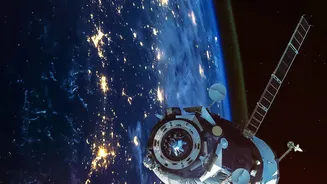
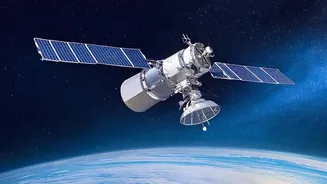
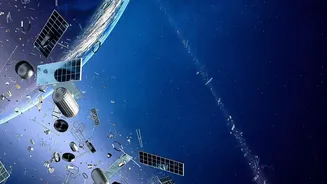
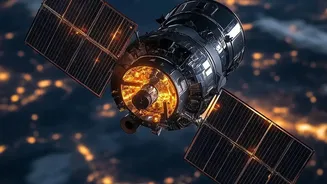
Low Earth orbit (LEO), the region of space up to 2,000 kilometres above our planet, is critical for modern life. It hosts satellites that provide us with everything from internet services and GPS navigation to vital climate data. But this valuable real
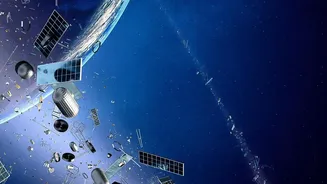
estate is cluttered. Decades of space activity have left behind a junkyard of defunct satellites, spent rocket stages, and fragments from past collisions. According to space agencies, there are over 34,000 objects larger than 10 cm being tracked, and an estimated 128 million pieces smaller than 1 cm. Even a tiny fleck of paint can be lethal in orbit, as objects in LEO travel at speeds exceeding 28,000 km/h. At that velocity, a small object carries enough kinetic energy to disable or destroy an active satellite, creating even more debris.
The Threat of a Domino Effect
The greatest fear for satellite operators is a scenario known as the Kessler Syndrome, proposed by NASA scientist Donald Kessler in 1978. He theorised that if the density of objects in LEO becomes too high, a single collision could trigger a chain reaction. One impact creates thousands of new fragments, each of which increases the probability of further collisions. This could create a cascade of destruction that renders entire orbital altitudes unusable for generations, cutting off access to space and crippling the global infrastructure we depend on. With the rise of large satellite constellations, the orbital environment is more congested than ever, making this once-hypothetical scenario a growing concern for both commercial and government space operators.
Enter Electrodynamic Tethers
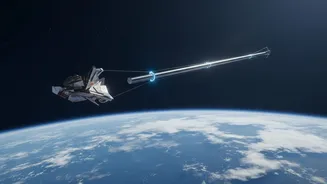
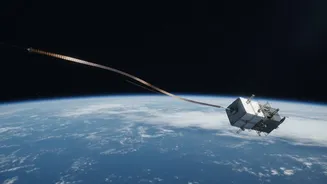
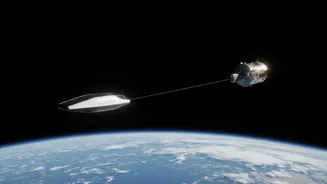
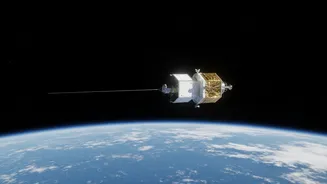
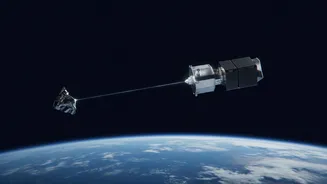
Amid this growing crisis, scientists and engineers are developing innovative solutions. One of the most promising is electrodynamic tether technology. Imagine a very long, thin, conductive wire deployed from a satellite. As this tether moves through the Earth's magnetic field at orbital speeds, it naturally generates an electric potential, similar to how a dynamo creates electricity. By controlling the flow of electric current through this tether, engineers can generate a force known as the Lorentz force. This force can be used to push or pull the satellite, providing thrust without using a single drop of propellant. It's a way to harness the natural environment of space to manoeuvre a spacecraft.
A Propellant-Free Force Field
So how does this protect an active satellite? The key is propellant-free manoeuvrability. Currently, if a satellite is on a collision course with a piece of debris, it must fire its onboard thrusters to move out of the way. This uses precious fuel, which shortens the satellite's operational lifespan and limits the number of avoidance manoeuvres it can perform. An electrodynamic tether system allows the satellite to generate its own thrust by interacting with the magnetic field. This allows it to make small, precise orbital adjustments to dodge incoming debris without consuming its finite fuel supply. In essence, it provides a sustainable way to sidestep danger, extending the life of the satellite and ensuring its mission continues uninterrupted.
The Future of Orbital Navigation
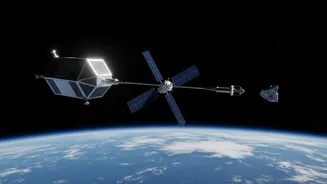
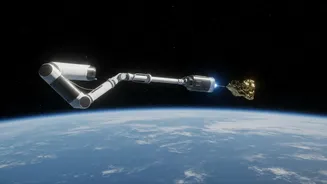
Beyond just protecting individual satellites, magnetic tethers have broader applications. The same technology can be used to de-orbit defunct satellites at the end of their life, helping to clean up space. By reversing the current, the tether creates drag that lowers the satellite's altitude until it safely burns up in the atmosphere. Several companies and space agencies, including the European Space Agency, are actively developing and testing these systems, with key demonstration missions planned. While challenges remain, such as ensuring the long-term durability of the tethers against micrometeoroid impacts, the technology is rapidly maturing. It represents a fundamental shift from disposable, fuel-limited systems to more sustainable, long-term operations in space.