




The Challenge of a Data Deluge
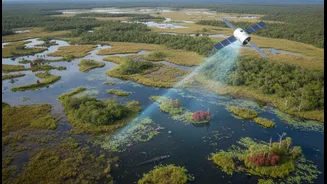
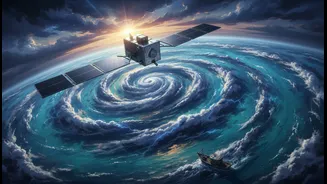
For decades, NASA has been our planet's most dedicated observer. A fleet of satellites continuously circles the globe, collecting staggering amounts of information about our oceans, atmosphere, and land. This data is crucial for understanding climate
change, but its sheer volume presents a colossal challenge. Scientists face a data deluge, with archives containing petabytes of information—enough to fill millions of high-definition movies. Manually analyzing this data to spot long-term trends, subtle changes, and critical patterns is an almost impossible task. This information bottleneck has made it difficult to extract the full value from NASA's incredible collection of Earth observations, slowing down our ability to model and predict climate shifts with the speed and accuracy the current moment demands.
Enter Prithvi: An AI for Planet Earth
To solve this problem, NASA, in collaboration with partners like IBM Research, has developed a family of AI 'foundation models' named Prithvi, the Sanskrit word for Earth. These aren't just simple algorithms; they are massive, sophisticated AI systems trained on vast, unlabeled datasets. One key model, Prithvi-weather-climate, was pre-trained on 40 years of NASA's own climate data. Think of it like a student who has spent decades studying every weather report and satellite image ever produced. This allows the AI to learn the fundamental physics of our climate system in a deeply intuitive way. Once this foundational knowledge is established, the model can be quickly adapted, or 'fine-tuned,' for a huge variety of specific tasks without needing extensive retraining.
From Raw Data to Actionable Insight
So, what does Prithvi actually do? Its applications are broad and transformative. A key function is 'downscaling,' where the AI takes coarse, global climate simulations and sharpens the resolution by a factor of 12, providing a much more detailed local picture without the massive computational cost of traditional methods. It can also fill in gaps in data, using its understanding of atmospheric dynamics to reconstruct what's happening even with incomplete information. Researchers are using it to improve forecasts for severe weather like hurricanes, track changes in land use, monitor natural disasters, and even predict crop yields. In May 2026, Prithvi even became the first geospatial foundation model to be deployed and tested in orbit, opening a new era of onboard data analysis for satellites.
Why This Matters for India
For a nation as geographically diverse and climate-vulnerable as India, this technology holds immense promise. More accurate, high-resolution climate models can lead to dramatically improved monsoon forecasting, which is the lifeblood of the country's agricultural sector. The ability to generate hyper-localized forecasts could help farmers make better decisions about planting and irrigation, boosting food security. Furthermore, AI-driven systems like TERRAHydro, another NASA project, are being developed to analyze water availability in critical regions like the Himalayas. This could provide vital insights into the health of the glaciers that feed India's major rivers. By offering better predictions for everything from heatwaves to cyclones, these AI tools can empower communities and governments to prepare for, mitigate, and adapt to the impacts of a changing climate more effectively.
The Future of AI-Powered Earth Science
The development of Prithvi and similar AI frameworks marks a significant pivot from simply collecting data to intelligently interpreting it at scale. NASA's commitment to making these models open-source means that researchers, startups, and governments around the world can build upon this work, accelerating innovation. While the massive energy consumption of training such large models is a valid concern, the potential benefits in optimizing our response to climate change are enormous. These AI models are not just about faster computers; they represent a new partnership between human scientists and artificial intelligence. This collaboration will be essential for navigating the complexities of our planet's future and turning decades of observation into the wisdom we need to protect our world.